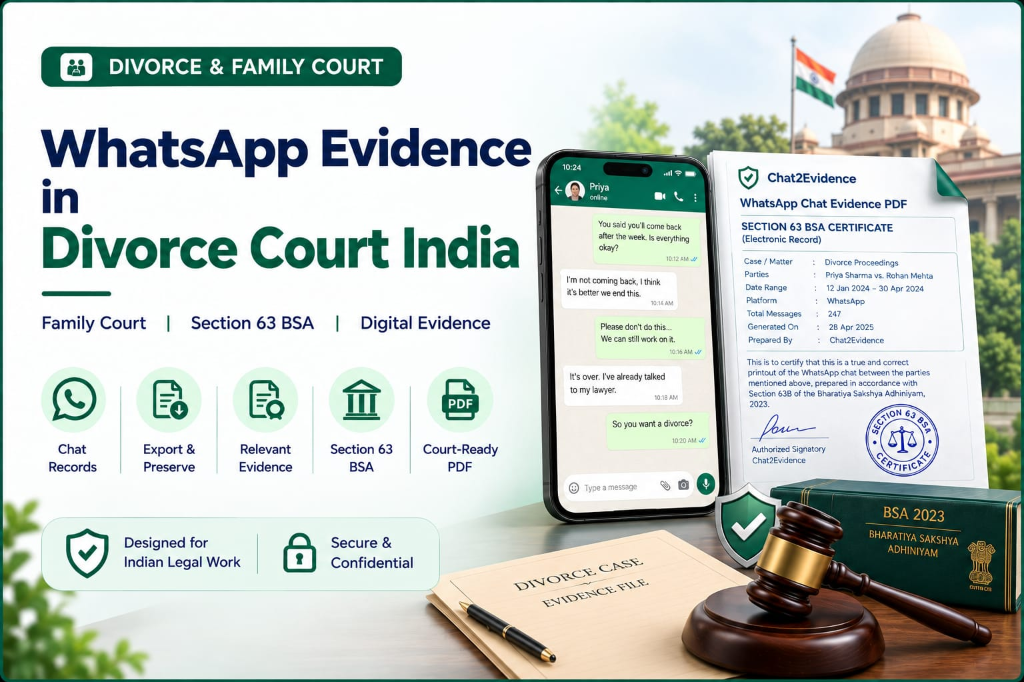
WhatsApp Evidence in Divorce & Matrimonial Court India: The Complete 2026 Guide
Home › Blog › WhatsApp Evidence in Divorce & Matrimonial Court India
Table of Contents
- Quick Answer: Are WhatsApp Chats Admissible in Divorce Court in India?
- Why Matrimonial Cases Are the Biggest Battlefield for WhatsApp Evidence
- The Legal Framework: HMA Grounds & the Evidence Map
- The 2025 Game-Changer: What the Supreme Court Settled About Secret Spousal Evidence
- Right to Privacy vs Right to Fair Trial: The Rules After Puttaswamy
- Marital Privilege: Section 122 IEA / Section 133 BSA and Why It Won't Save You
- Proving Mental Cruelty (Section 13(1)(ia) HMA) With WhatsApp Chats
- Proving Adultery After Joseph Shine: Decriminalized, But Still a Divorce Ground
- Desertion, Income Concealment & Maintenance: The Hidden Power of Chats
- Exhibiting WhatsApp Evidence in Matrimonial Petitions: Step-by-Step
- Secretly Obtained Evidence: What's Admissible and What Exposes You
- Protective Orders & Injunctions: Stopping WhatsApp Harassment
- Case Study: How Certified Chats Shifted a Contested Divorce
- Cross-Examination Checklist for Matrimonial WhatsApp Evidence
- 7 Fatal Mistakes in Matrimonial WhatsApp Evidence
- Frequently Asked Questions
- Conclusion & Action Plan
Quick Answer: Are WhatsApp Chats Admissible in Divorce Court in India?
Yes — WhatsApp chats are admissible in Indian divorce and matrimonial proceedings, and they are among the most decisive evidence a Family Court sees. But admissibility comes with conditions, and the conditions are where matrimonial litigants most often stumble.
Here is the complete position in one paragraph:
WhatsApp chats are admissible before Family Courts under Section 63 of the Bharatiya Sakshya Adhiniyam 2023 (formerly Section 65B, Indian Evidence Act). Following Arjun Panditrao Khotkar v. Gorantyal (2020), a chat exhibit must carry a certificate identifying the record, describing how it was produced, giving device particulars, and confirming no tampering — or the original phone must be produced in court. In July 2025, the Supreme Court in Vibhor Garg v. Neha went further and held that even secretly recorded conversations between spouses are admissible in matrimonial disputes, because the spousal-communication privilege in Section 122 IEA contains an express exception for proceedings between married persons, and privacy cannot be used to defeat a fair trial.
In plain terms: your chats — and your spouse's chats with you — can be used in your divorce case. The only real question is whether yours are presented in a form that survives the certification gate and the inevitable authenticity challenge.
⚡ Get your matrimonial evidence court-ready in 5 minutes: Chat2Evidence converts your exported WhatsApp chat into a chronological, paginated PDF with an auto-drafted Section 63 BSA certificate and SHA-256 hash — entirely in your browser, zero upload, full confidentiality. ₹999.
Why Matrimonial Cases Are the Biggest Battlefield for WhatsApp Evidence
Matrimonial litigation is, by volume, the largest use case for WhatsApp evidence in India. The reasons are structural:
- The conduct happens in private. Cruelty, demands, threats, and admissions rarely have witnesses. Unlike a commercial dispute with contracts and invoices, a marriage's most important moments happen in bedrooms and chat windows.
- The parties text constantly. Indian couples in conflict do not stop communicating — they communicate more, and more recklessly, over text. Anger produces admissions.
- The proof standard is civil. Divorce and maintenance require only the preponderance of probabilities — which side's account is more likely. A handful of authenticated, damning messages can tip that balance by themselves.
- Family Courts have relaxed procedure. Under Sections 14 and 20 of the Family Courts Act 1984, Family Courts are not rigidly bound by the strict rules of evidence and procedure — but, as courts have clarified, that flexibility does not abolish the certification requirement for electronic records. Relaxed procedure is not relaxed authentication.
The result: matrimonial petitions live and die on chat evidence — and the side with certified, complete, well-indexed chats almost always beats the side with a folder of screenshots.
The Legal Framework: HMA Grounds & the Evidence Map
Under the Hindu Marriage Act 1955 (and parallel provisions in the Special Marriage Act 1954 and personal laws), WhatsApp evidence maps onto specific grounds like this:
| Ground | Provision | What WhatsApp Chats Prove | Proof Standard |
|---|---|---|---|
| Adultery | Section 13(1)(i) HMA | Romantic/intimate conversations, hotel plans, photos, admissions | Preponderance; corroboration strengthens |
| Cruelty (mental) | Section 13(1)(ia) HMA | Sustained abuse, humiliation, threats, taunts, harassment | Preponderance; cumulative conduct matters |
| Desertion | Section 13(1)(ib) HMA | Messages showing refusal to return, communication cutoff | Two-year continuous desertion + intent |
| Maintenance / income | Section 125 CrPC / Section 144 BNSS | Business chats, lifestyle evidence contradicting income affidavits | Preponderance |
| Custody (welfare factors) | Section 26 HMA / GWA | Neglect admissions, substance abuse, instability | Best interests of child |
| Restitution of conjugal rights | Section 9 HMA | Willingness to cohabit, refusal to return | Conduct evidence |
For mental cruelty, the Supreme Court's illustrative catalogue in Samar Ghosh v. Jaya Ghosh (2007) 4 SCC 511 and the analysis in Vinita Saxena v. Pankaj Pandit (2006) 3 SCC 778 control: no uniform definition, but sustained conduct causing reasonable apprehension of harm to body or health — including repeated humiliation, taunts, and harassment — qualifies. WhatsApp message threads are tailor-made to demonstrate sustained conduct.
💡 The drafting insight: "Sustained pattern" is the phrase that wins cruelty cases on chat evidence. A single rude message proves a bad evening; six months of timestamps abusive messages prove a marriage.
The 2025 Game-Changer: What the Supreme Court Settled About Secret Spousal Evidence
For years, Indian High Courts were split on the central matrimonial evidence question: can a spouse use recordings or messages obtained without the other spouse's knowledge?
- The Punjab and Haryana High Court (and several others) had barred such material, holding that recordings made without consent infringe the right to privacy recognized in K.S. Puttaswamy v. Union of India (2017) 10 SCC 1.
- Other High Courts (Karnataka, Calcutta, Bombay) had admitted such evidence, pointing to the exception in Section 122 IEA for suits between married persons.
In July 2025, the Supreme Court resolved the conflict in Vibhor Garg v. Neha. The ruling is the most important matrimonial-evidence judgment of the decade, and every litigant should understand its three holdings:
- Secretly recorded conversations between spouses are admissible in matrimonial disputes. The bar on disclosure in Section 122 IEA applies to proceedings between strangers or where one spouse gives evidence about the other in unrelated litigation. Where the spouses are themselves litigating (divorce, maintenance, custody), the statutory exception lifts the privilege.
- Privacy does not defeat the fair trial. The Court held that if the right to privacy between spouses is the very basis of Section 122, then the exceptions to that right flow from Section 122 itself. A spouse cannot block relevant evidence in a matrimonial case by invoking privacy — the right to a fair trial and to prove one's case is also an aspect of Article 21.
- Snooping is a symptom, not a cause. The Court rejected the argument that admitting such evidence would encourage spousal surveillance: "If the marriage has reached a stage where spouses are actively snooping on each other, that is in itself a symptom of a broken relationship... snooping between partners is an effect and not a cause of marital disharmony."
Around the same period, the Supreme Court refused to interfere with a Delhi High Court order allowing a wife, in divorce proceedings alleging adultery, to summon her husband's hotel records and call detail records — to be produced before the Family Court in sealed cover. The Court held "no interference is called for" with the Family Court's and High Court's approach.
🎯 What this means for you in 2026: The "you obtained it secretly, it's inadmissible" objection is now largely dead between spouses in matrimonial litigation. What still matters — completely — is authentication: certification under Section 63 BSA, attribution to numbers, and integrity via hash. The secrecy objection is gone; the fabrication objection is very much alive.
Right to Privacy vs Right to Fair Trial: The Rules After Puttaswamy
With the 2025 rulings, the practical rulebook looks like this:
| What You Did | Admissibility in Matrimonial Case | Your Risk |
|---|---|---|
| Exported your own WhatsApp chats (your phone, your account) | ✅ Fully admissible with Section 63 BSA certificate | None — this is the gold standard |
| Read/kept chats your spouse sent to you | ✅ Admissible — Vibhor Garg (2025); Section 122 exception | None |
| Secretly recorded conversations between you and your spouse | ✅ Admissible — Vibhor Garg (2025) | None in the matrimonial case itself |
| Accessed chats from a shared family device where the account was logged in | ⚠️ Generally admitted by Family Courts, but fact-sensitive; disclose the circumstances honestly | Low; authentication questions |
| Hacked/phished your spouse's WhatsApp, installed spyware, guessed passwords | ❌ Evidence vulnerable to exclusion; act itself criminal | IT Act 2000 (Section 66 etc.), Telegraph Act liability |
| Illegally tapped spouse's calls with third parties | ❌ Strongly vulnerable — privacy of non-parties engaged; Vibhor Garg concerned spousal communications | Criminal exposure; exclusion likely |
🚨 The bright line: Evidence that comes from your own device and your own account is safe, certifiable, and dominant. Evidence that comes from breaking into someone else's account or intercepting third-party communications can both fail in court and create criminal liability. Preserve your side lawfully; obtain the other side's records through court-ordered production (summons to WhatsApp/Meta or telecom providers, applications for discovery under the Family Courts Act) — the Delhi High Court's sealed-cover CDR/hotel-records order shows the courts will compel exactly this.
Marital Privilege: Section 122 IEA / Section 133 BSA and Why It Won't Save You
Many spouses facing a chat exhibit raise a instinctive objection: "Those were private communications between husband and wife — Section 122 makes them inadmissible."
Here is why that objection almost never works in a matrimonial case:
Section 122 of the Indian Evidence Act (now Section 133 BSA) provides that a spouse cannot be compelled — and even cannot be permitted, absent the other spouse's consent — to disclose communications made to them during the marriage. But it contains two express exceptions:
- Proceedings in suits between married persons — i.e., divorce, judicial separation, maintenance, custody between the spouses themselves.
- Proceedings where one spouse is prosecuted for a crime committed against the other.
In a divorce case, exception (1) applies by its own terms. As the Supreme Court explained in Vibhor Garg, the privilege exists to protect marital confidence in the world at large — it was never designed to let a spouse conceal relevant evidence from the court in a dispute between the spouses themselves. The Law Commission's rationale (protecting domestic peace) collapses when domestic peace is precisely what is before the court.
Two additional points from the case law worth knowing:
- The bar attaches to disclosure by the recipient spouse — it does not make the communication itself radioactive. A chat record produced through proper certification can come in even where oral testimony about it might have been restricted.
- The privilege covers communications made during subsistence of the marriage and does not extend to communications with third parties (paramours, in-laws, friends) — which are relevant to adultery and conspiracy allegations.
💡 Practical translation: If you are the party holding the chats, marital privilege is not a shield available to your opponent in your own matrimonial case. If you are the party who sent incriminating messages, the answer is not a privilege objection — it is attacking authenticity, completeness, and context.
Proving Mental Cruelty (Section 13(1)(ia) HMA) With WhatsApp Chats
Mental cruelty is the most commonly pleaded ground in contested Indian divorces — and WhatsApp threads are its best documentary proof. The framework:
What qualifies (per Samar Ghosh and Vinita Saxena)
- Sustained verbal abuse, humiliation, and name-calling directed at the spouse or their family
- Threats — of false cases, of self-harm leveraged as control, of violence
- Repetitive taunts about appearance, infertility, income, family
- Harassment campaigns — message floods, late-night calls followed by abusive texts, group-chat humiliation
- Isolation and control — dictating movements, demanding account passwords, monitoring
- False allegation messaging — broadcasting accusations to relatives' WhatsApp groups
What makes chat evidence win a cruelty finding rather than just support it
| Weak Presentation | Strong Presentation |
|---|---|
| 12 screenshots of the worst messages | Complete certified thread showing the pattern over months |
| No dates, contact names only | Server timestamps + +91 numbers, Section 63 certificate |
| Messages without context | Full thread — including your own calm replies, which show provocation pattern |
| Collected after the petition was filed | Exported and hashed before litigation; pre-suit timestamp |
The judicial psychology
Family Court judges see fabricated cruelty claims daily. What persuades them is volume, continuity, and contemporaneity — a thread that shows the same abuse every week for a year, timestamped, unedited, and certified. That is very hard to fake convincingly and very hard to explain away.
⚠️ Fair warning both ways: Messages you sent count too. If the thread shows mutual abuse, the court sees mutual abuse. Complete exports protect you precisely because they are complete — do not curate yourself into a credibility problem.
Proving Adultery After Joseph Shine: Decriminalized, But Still a Divorce Ground
Joseph Shine v. Union of India (2018) struck down Section 497 IPC and decriminalized adultery. A common misconception followed: "Adultery doesn't matter anymore." False.
Adultery remains a fault ground for divorce under Section 13(1)(i) HMA (and equivalent provisions elsewhere). What changed is that it is no longer a crime — it is still civilly decisive.
How WhatsApp evidence proves adultery
| Evidence Type | What It Shows | Strength |
|---|---|---|
| Romantic/intimate message threads with a third party | Nature of relationship | Strong, especially with photos |
| Hotel/flight booking discussions, meeting plans | Opportunity and intent | Strong when corroborated by records |
| Admissions ("woh sirf dost hai" contradicted by content) | Consciousness + falsehood | Very strong in cross-examination |
| Photos/videos exchanged | Direct evidence | Strong; certify media properly |
| Spouse's chats with you confessing or explaining | Admission against interest | Among the strongest civil evidence |
The corroboration toolkit (post-2025)
Following the Delhi High Court approach upheld by the Supreme Court, you can apply to summon:
- Call detail records (CDRs) of the spouse's number (sealed cover to protect privacy)
- Hotel/guesthouse records for alleged rendezvous dates
- WhatsApp/Meta records via lawful process (increasingly ordered in serious matters)
The chats give you the dates, names, and places; the third-party records corroborate them. Chat + corroboration is close to unanswerable on the civil standard.
💡 Standard of proof reminder: You need the court to find adultery more likely than not — not beyond reasonable doubt. A certified, corroborated chat thread clears that bar routinely.
Desertion, Income Concealment & Maintenance: The Hidden Power of Chats
Two underrated uses:
Desertion (Section 13(1)(ib)): Requires two years of continuous desertion plus animus deserendi (intention). WhatsApp is where desertion's intention is written — "main wapas nahi aa rahi/aa raha," refusal to communicate, messages to third parties about never returning. Export the entire period; the thread is the desertion timeline.
Maintenance & income concealment: Spouses routinely swear "zero income" affidavits while conducting business on WhatsApp. The most damaging exhibits:
- Negotiating deals, quoting prices, closing sales in business chats
- Discussing salaries, bonuses, overseas assignments
- Sharing lifestyle evidence — foreign trip plans, vehicle bookings, jewellery purchases, restaurant statuses
- Group-chat boasts about income
Certified chats of this kind routinely convert zero-maintenance orders into substantial interim maintenance under Section 125 CrPC / Section 144 BNSS. (The full protocol for this is covered in our dedicated guide on maintenance evidence.)
Exhibiting WhatsApp Evidence in Matrimonial Petitions: Step-by-Step
The matrimonial filing sequence, from preservation to exhibit-marking:
- Preserve immediately — airplane mode, disable sync, photograph chats on-screen, record device particulars (IMEI via
*#06#). - Export natively with media (iOS: contact name → Export Chat → Attach Media; Android: ⋮ → More → Export chat → Include media).
- Transfer via USB/local share; hash the ZIP (SHA-256); email the hash to yourself and one trusted person. The pre-suit timestamp is your anchor.
- Convert to court-format PDF: chronological, +91 numbers (not names), media inline, continuous pagination with exhibit labels.
- Draft the Section 63 BSA certificate — four limbs: identification, manner of production, device particulars, Section 63(1) conditions — plus the hash paragraph and Part B expert verification where used. File it with the record.
- Annex to your affidavit with a one-page index: Exhibit number → page range → the specific fact it proves ("Exhibit C-4: respondent's refusal to return to matrimonial home, Jan–Mar 2026").
- Family Court privacy rules: under the Delhi Family Courts (Amendment) Rules, 2024 (Chapter VI, Rule 17), parties must not extract sensitive private content in pleadings without the court's leave — file sensitive exhibits through proper annexures and seek directions where content is explicit. Other states are adopting similar privacy-protective rules; ask your advocate about local practice.
- Rehearse your oral foundation: ownership of number → export by you on [date] → hash matches → nothing edited.
⚡ Steps 3–5 take most litigants days of error-prone manual work — Chat2Evidence does them in ~5 minutes from your exported ZIP, zero upload. ₹999.
Secretly Obtained Evidence: What's Admissible and What Exposes You
Given the 2025 rulings, here is the safe-operating map:
| Method | Verdict | Why |
|---|---|---|
| Export of your own chats | ✅ Always | Your device, your account, cleanest custody |
| Messages your spouse sent you, kept by you | ✅ Always | Section 122 exception; Vibhor Garg |
| Secret recordings of conversations with your spouse | ✅ In matrimonial cases | Vibhor Garg (2025): admissible; privacy balanced against fair trial |
| Screen recordings of chats on a shared device | ⚠️ Usually admitted; disclose circumstances | Fact-sensitive; authentication still required |
| Spyware/hacked access to spouse's account | ❌ Don't | IT Act 2000 offences; exclusion risk; countersuit exposure |
| Tapped calls with third parties | ❌ Don't | Privacy of non-parties; Telegraph Act/IT Act liability; likely excluded |
🚨 The strategic rule: in matrimonial litigation, the lawful route to the other side's records is court compulsion, not self-help. Summons, discovery applications, and sealed-cover production orders exist precisely so you don't have to hack anything.
Protective Orders & Injunctions: Stopping WhatsApp Harassment
If the conflict flows the other way — your spouse (or in-laws) harassing you over WhatsApp — you have remedies beyond using the messages as evidence:
- Civil injunction from the Family Court (or civil court) restraining specific conduct: defamatory status updates, group-post campaigns, threats, or contact altogether. Courts grant these readily where message evidence shows a pattern.
- Criminal defamation (Section 356 BNS) for broadcasts that harm reputation.
- Cruelty/dowry provisions where harassing messages evidence the offence.
- Contempt if injunctions are violated.
For every one of these, the evidentiary requirement is the same: preserved, certified, timestamped messages — exported and hashed as they arrive, not assembled from memory after filing.
Case Study: How Certified Chats Shifted a Contested Divorce
A composite case study reflecting a common pattern in Delhi Family Court practice. Names changed; the legal mechanics are exactly as described.
The dispute: "Kavita" filed for divorce on cruelty grounds after five years of marriage. Her husband's family counter-pleaded that she was argumentative and had deserted the matrimonial home voluntarily. The case was heading toward the classic he-said-she-said stalemate that drags for years.
What Kavita had: Three years of WhatsApp messages from her husband and mother-in-law — a sustained pattern of taunts about her family, demands that she quit her job, threats that she would "never see her son" if she pursued her career, and finally messages telling her not to return home.
What she almost did wrong: Her first instinct was to print 60 screenshots of the worst messages. Her advocate stopped her.
What was done instead:
- Same-day preservation — airplane mode, sync off, device photo, IMEI recorded.
- Full native export with media of both chat threads (husband and mother-in-law).
- SHA-256 hash generated and emailed to Kavita and her sister — before the petition was drafted.
- Court-format PDFs — chronological, +91 numbers, inline media, paginated.
- Section 63 BSA certificates for each thread, four limbs completed, hash paragraph included.
- One-page index mapping each exhibit to a pleaded fact.
The cross-examination moment: The husband's counsel attacked the messages as "cherry-picked and possibly fabricated." The response was structural, not rhetorical: the complete threads included messages favourable to the husband, the timestamps were server-side, the numbers matched the parties' own admissions, and the hash predated the petition. The objection died in one hearing.
Outcome: The Family Court treated the sustained pattern as establishing mental cruelty under Section 13(1)(ia); the desertion counter-plea collapsed against the thread showing she was told not to return. Decree of divorce on cruelty grounds within fourteen months — unusually fast for a contested matter.
The transferable lessons:
- Complete beats curated, every time. The unfavourable-to-her messages weren't a liability; they were the authenticity proof.
- The pre-suit hash was the case's spine. Everything else was presentation.
- Index-to-pleading mapping is what turns 200 pages of chat into 5 pages of argument.
Cross-Examination Checklist for Matrimonial WhatsApp Evidence
| # | Question You Will Face | The Proof That Answers It |
|---|---|---|
| 1 | "You selected only the messages that help you." | Complete certified thread — including unfavourable messages; hash proves no excision. |
| 2 | "These names could be anyone. Where are the numbers?" | +91 numbers on every message; SIM registration/CAF links numbers to parties. |
| 3 | "This chat could be fabricated — such apps exist." | Native export structure + server timestamps + pre-suit hash + Section 63 certificate. |
| 4 | "When did you 'find' these? After filing?" | Export-date records and the pre-suit hash email. |
| 5 | "Did you edit, delete, or rearrange anything?" | "No — verify the hash." One-line, verifiable, devastating. |
| 6 | "This was a private marital communication — Section 122 bars it." | The Section 122 exception for suits between married persons; Vibhor Garg v. Neha (SC, 2025). |
| 7 | "You obtained this by snooping — privacy violation." | Own-device export needs no snooping; and after Vibhor Garg, even secret spousal recordings are admissible. |
| 8 | "Where is the phone? Produce it." | Available and intact; will be produced on court direction (or produced proactively). |
7 Fatal Mistakes in Matrimonial WhatsApp Evidence
🚨 Mistake 1 — Screenshot folders. Unverifiable, unhashable, number-less. The single fastest way to turn strong evidence into weak evidence.
🚨 Mistake 2 — Self-help surveillance. Spyware and hacked accounts can void your evidence and create your own criminal exposure. Lawful preservation and court-ordered production only.
🚨 Mistake 3 — Curating the thread. Removing your own bad messages converts a winning exhibit into a credibility catastrophe the moment the full record surfaces.
🚨 Mistake 4 — Filing without certification. Family Courts are flexible on procedure, not on authentication. Uncertified electronic records are excluded or ignored — Arjun Panditrao applies in the Family Court too.
🚨 Mistake 5 — Waiting for the petition before preserving. The counterparty deletes, blocks, and changes numbers once litigation looms. Export and hash before the first legal notice.
🚨 Mistake 6 — Broadcasting sensitive content in pleadings. Explicit material filed without leave can violate privacy-protective rules (like Delhi's 2024 Family Courts amendment) and alienate the judge. Use annexures and seek directions.
🚨 Mistake 7 — Overclaiming. One ambiguous friendly message is not adultery; one rude message is not cruelty. Plead what the thread actually proves — overreach hands the other side a credibility attack.
Frequently Asked Questions
1. Are WhatsApp chats admissible in divorce court in India?
Yes — with Section 63 BSA certification or production of the original device. Family Courts admit WhatsApp evidence routinely in cruelty, adultery, desertion, maintenance, and custody matters.
2. Can messages between me and my spouse be used even though they're private?
Yes. Section 122 IEA (Section 133 BSA) protects marital communications, but its express exception covers proceedings between the spouses. The Supreme Court confirmed this in Vibhor Garg v. Neha (July 2025).
3. Can I use my spouse's WhatsApp chats with a third party to prove adultery?
Yes, if lawfully obtained — e.g., chats that came to you, screenshots from a shared device, or records produced through court summons. Hacked or spyware-obtained material risks exclusion and criminal liability.
4. What kind of WhatsApp messages prove mental cruelty?
Sustained patterns — abuse, humiliation, threats, harassment campaigns, controlling behavior — over months, with server timestamps. Isolated messages rarely suffice; the pattern wins.
5. Do I need a Section 63 BSA certificate in Family Court if the court has relaxed evidence rules?
Yes. Sections 14 and 20 of the Family Courts Act relax procedure, not authentication. Courts admit certified records and discount or exclude uncertified ones.
6. Can WhatsApp chats prove my spouse's income for maintenance?
Yes — business chats, lifestyle evidence, and admissions contradicting income affidavits are among the most effective maintenance evidence available. See our dedicated maintenance guide for the full protocol.
7. Are voice notes between spouses admissible?
Yes — same certification framework, plus the five Ram Singh (1985) rules for recorded/audio evidence, and a certified verbatim transcript.
8. Can I stop my spouse from posting about me on WhatsApp during the case?
Yes — Family Courts grant injunctions restraining defamatory or harassing posts; violations invite contempt. Preserve every post with export and hash.
9. My spouse deleted the messages. Is my copy still usable?
Yes. Your export preserves your record of the conversation. "This message was deleted" markers are themselves useful evidence, and deletion by the other side can support adverse inferences (Section 119 BSA).
10. How quickly can I prepare my matrimonial WhatsApp evidence?
Manually: hours to days (export, formatting, certificate drafting, advocate review). With Chat2Evidence: about 5 minutes from exported ZIP to court-ready PDF + Section 63 BSA certificate + hash, with zero upload so your private marital matters never touch a third-party server.
Conclusion & Action Plan
WhatsApp evidence has quietly become the decisive battlefield of Indian matrimonial litigation. The Supreme Court's 2025 rulings removed the old privacy objection; what remains is a pure authentication contest — and authentication is a procedural discipline, which means it is entirely within your control.
Your action plan:
- Today (15 minutes): Preserve — airplane mode, sync off, on-screen photos, device particulars. Export the relevant threads with media, hash them, email the hashes to yourself and one trusted person.
- This week: Convert to court-format PDFs with +91 numbers, pagination, and inline media; draft Section 63 BSA certificates.
- Before filing: Index every exhibit to a pleaded fact; check local Family Court privacy rules for sensitive content; rehearse your oral foundation.
Your three options
| Option | What You Get | Best If |
|---|---|---|
| 1. Manual (Free) | This guide's protocol, templates, and checklists | Short threads, time available, detail-oriented advocate |
| 2. Chat2Evidence — ₹999 (Recommended) | Court-ready chronological PDF + auto Section 63 BSA certificate + SHA-256 hash in ~5 minutes, 100% client-side (zero upload) | You want it done right today, with total privacy over sensitive marital material |
| 3. Forensic lab (₹15,000–₹50,000) | Device imaging, deleted-content recovery, expert testimony | High-conflict litigation where the other side fields forensics |
For most matrimonial matters, Option 2 delivers forensic-grade evidence hygiene at a fraction of the cost — with the privacy guarantee that matters most when the evidence is your private life.
⚡ Turn your WhatsApp chats into court-ready matrimonial evidence in 5 minutes — ₹999, zero upload, Section 63 BSA certificate and SHA-256 hash included. Your chats never leave your phone.
Related Guides
- Are WhatsApp Chats Valid in Court in India? — the master admissibility framework this article applies to matrimonial cases
- WhatsApp Evidence in Maintenance Cases (Section 125 CrPC / Section 144 BNSS) — income-concealment and lifestyle evidence deep-dive
- Authenticate WhatsApp Screenshots for Court Submission — why screenshot folders fail, and the protocol that replaces them
- Preserve WhatsApp Evidence Before Filing a Case — the emergency preservation protocol
- How to Export WhatsApp Chat for Court — the export walkthrough every protocol above builds on
Disclaimer: This guide is legal information, not legal advice, and does not create an advocate-client relationship. Case law and statutes are stated as of September 2026. Matrimonial litigation is fact-sensitive — consult a qualified family law advocate for your specific matter.