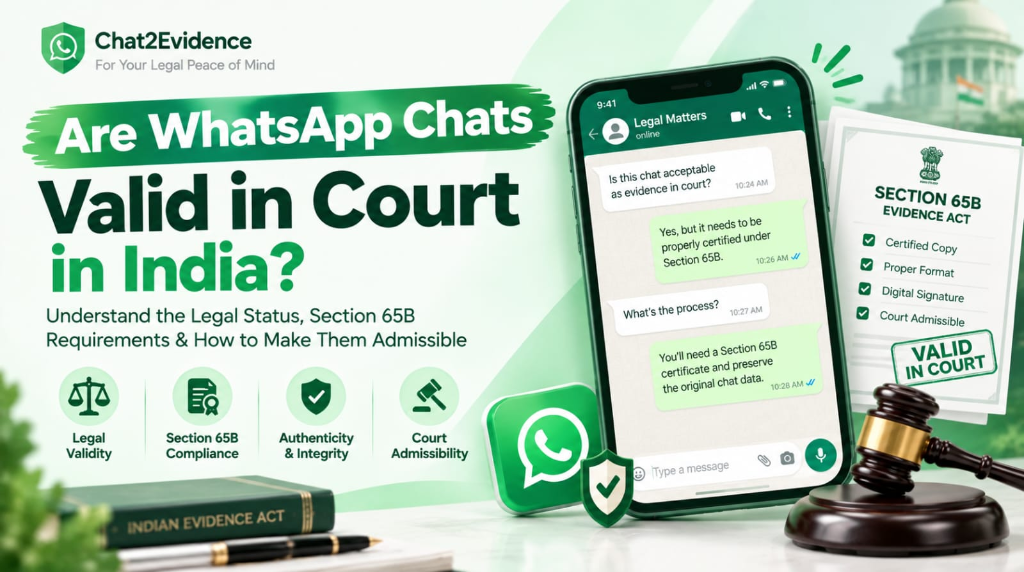
Are WhatsApp Chats Valid in Court in India? The Definitive 2026 Answer
Home › Blog › Are WhatsApp Chats Valid in Court in India?
Table of Contents
- Quick Answer: Yes — But "Valid" and "Admissible" Are Not the Same Thing
- The Legal Status of WhatsApp Evidence in India: A 2026 Snapshot
- Primary vs Secondary Evidence: The Two Doors to WhatsApp Proof
- Section 65B vs Section 63 BSA: The Complete Transition Guide
- The Supreme Court Rulebook: Anvar, Shafhi, and Arjun Panditrao
- The 4 Non-Negotiable Pillars of WhatsApp Evidence
- Criminal vs Civil Courts: Why the Same Chat Faces Different Tests
- The 7 Reasons Indian Courts Dismiss WhatsApp Evidence (And How to Beat Each)
- The Validity Test: Is Your WhatsApp Evidence Court-Ready?
- Section 63 BSA Certificate Template for Chat Evidence
- Court Filing Checklist: Making Validity Admissible
- Frequently Asked Questions
- Conclusion & Action Plan
Quick Answer: Yes — But "Valid" and "Admissible" Are Not the Same Thing
Yes, WhatsApp chats are valid — and admissible — legal evidence in India. They are "electronic records" under Section 61 of the Bharatiya Sakshya Adhiniyam (BSA), 2023, which declares electronic and digital records to be documents with the same legal force as paper. That was true under Section 65B of the old Indian Evidence Act, 1872, and it remained true when the BSA replaced the Evidence Act on 1 July 2024.
But here is the distinction that decides actual cases:
"Valid in law" means a WhatsApp chat can be evidence. "Admissible in your case" means your specific chat record will be received by the court — and that depends entirely on how you prove it.
The Supreme Court settled the method in Arjun Panditrao Khotkar v. Kailash Kushanrao Gorantyal (2020) 7 SCC 1: electronic records produced without the original device must come with a certificate under Section 65B(4) — now Section 63(4) BSA — and that certificate is a condition precedent to admissibility. No certificate, no admission — regardless of how genuine the chat is. The Delhi High Court applied this to WhatsApp specifically in Dell International Services v. Adeel Feroze (2024), refusing to even read uncertified WhatsApp screenshots.
So the accurate one-line answer is:
WhatsApp chats are valid evidence in every Indian court — civil, criminal, family, consumer, and tribunal — provided they are proved through one of the two Supreme Court-approved routes: the original device in the witness box, or a certified record under Section 63 BSA.
Everything below shows you exactly how to satisfy that test, and how to survive the seven attacks that get chat evidence thrown out.
⚡ Want to know if your chat would survive an objection right now? Chat2Evidence converts your WhatsApp export into a court-ready certified record — chronological PDF, auto-drafted Section 63 BSA certificate, and SHA-256 hash — in about 5 minutes, ₹999, entirely in your browser. Zero upload; your chats never leave your device.
The Legal Status of WhatsApp Evidence in India: A 2026 Snapshot
Let us clear away the confusion that outdated blogs and WhatsApp University have created. Here is where the law actually stands today:
| Question | The 2026 Answer | Source |
|---|---|---|
| Are WhatsApp chats "documents" in the eyes of law? | Yes. Electronic records are documents with the same evidentiary force as paper. | Section 61 BSA 2023 (formerly Section 65A/2(t), 3 IEA) |
| Can they be primary evidence? | Yes — the phone itself, produced and testified to. | Section 62 BSA (formerly Section 62 IEA); Arjun Panditrao (2020) |
| Can a printout/screenshot/PDF be evidence? | Yes — as secondary evidence if certified. | Section 63 BSA (formerly Section 65B IEA) |
| Is the certificate mandatory? | Yes — a condition precedent. | Anvar (2014); Arjun Panditrao (2020); Section 63(4) BSA |
| Can oral testimony substitute for the certificate? | No. | Arjun Panditrao (2020) |
| Does a denial by the other party kill it? | No — it triggers scrutiny of your proof, which certification is designed to survive. | Ram Singh v. Col. Ram Singh (1985) framework |
| Are chats valid in criminal trials? | Yes, with a stricter standard of proof. | Tomaso Bruno (2015); Tukaram S. Dighole (2010) |
| Are deleted chats usable? | Only if preserved (export/backup) before deletion. | Preservation doctrine; spoliation principles |
🚨 The most dangerous misconception in 2026: "WhatsApp chats are not valid evidence in India" — a claim still repeated in forwarded messages and decade-old blog comments. It is false, and has been false since at least 2014. What is true is that uncertified, unproved chats are worthless — which is a different statement entirely, and entirely within your control to fix.
Primary vs Secondary Evidence: The Two Doors to WhatsApp Proof
Sections 61–63 BSA give you exactly two doors through which a WhatsApp chat can enter the record. Arjun Panditrao (2020) made the choice explicit. Understanding both — and their costs — is the foundation of every WhatsApp evidence strategy in India.
Door A — Primary Evidence: produce the original device
You walk into the witness box with the actual phone, prove it is yours (number registration, SIM, testimony), open the chat on the device in court, and let the judge (and opposing counsel) see it live.
| Aspect | What It Means for You |
|---|---|
| Legal basis | Section 62 BSA — the document produced is the original |
| Certificate needed? | No. This is precisely what Arjun Panditrao clarified: "if an electronic record is used as primary evidence... the same is admissible in evidence, without compliance with the conditions of Section 65B" |
| The catch | You hand your phone into the court file. Total disclosure of your private life, risk of damage/loss, and the court may retain it |
| Best for | Short, decisive chats in hearings where the device can be shown briefly — rarely for full trials |
Door B — Secondary Evidence: certified record + Section 63 certificate
You export the chat natively, convert it to a court-format PDF, generate a SHA-256 hash, seal the source files on write-once media, and file the Section 63(4) certificate — all without surrendering your phone.
| Aspect | What It Means for You |
|---|---|
| Legal basis | Section 63(1) BSA — a printout/PDF is admissible as a document when the Section 63(2) conditions are met and the Section 63(4) certificate accompanies it |
| Certificate needed? | Yes — mandatory, every time the record is submitted |
| The catch | You must build the chain properly: export, hash, certificate, sealed media, attribution. Skipping steps is what gets evidence rejected |
| Best for | Essentially every real case — long threads, voice notes, media, and any matter where you cannot risk your phone |
Why nearly every litigant chooses Door B
Producing your phone sounds simple until you think it through: the court retains the exhibit; every notification, photo, and chat on the device is now in the file; the device is your daily lifeline; and a factory reset or a failed battery in custody can destroy the very evidence you produced. Courts know this — which is why the certified-record route exists and why the BSA's Schedule (Part A + Part B certificate with expert verification) was designed to make Door B stronger, not merely tolerable.
🎯 The strategic synthesis: Door A is your fallback if your Door B file is attacked; Door B is your primary plan. A witness who can calmly say "the record is certified and hash-verified, and the original device is in my pocket and available on direction" presents the strongest possible evidentiary posture — the court's two tests are both satisfied before either is even applied.
Section 65B vs Section 63 BSA: The Complete Transition Guide
On 1 July 2024, the Indian Evidence Act, 1872 was repealed and replaced by the Bharatiya Sakshya Adhiniyam, 2023. Every article written before mid-2024 quotes Section 65B; every proceeding filed after the transition must cite Section 63. Here is the complete mapping, with what actually changed:
| Aspect | Section 65B, Evidence Act 1872 | Section 63, BSA 2023 | Practical Impact |
|---|---|---|---|
| Status | Repealed (pre-1 July 2024 proceedings) | In force (proceedings after commencement) | Cite Section 63 BSA in new filings |
| Certificate for electronic records | Mandatory (Anvar, Arjun Panditrao) | Mandatory — Section 63(4) | Unchanged in substance |
| Media covered | Optical/magnetic media | Expanded: expressly includes communication devices, laptops, smartphones; cloud and network storage treated as part of the same device system (Section 63(3)) | WhatsApp, cloud backups, multi-device setups squarely covered |
| Certificate format | No statutory format — drafting varied wildly, causing rejections | Standardized Schedule: Part A + Part B, with an expert verification element | Fewer fatal drafting defects |
| Filing discipline | Certificate could be filed later by court direction | Certificate submitted "at each instance where the electronic record is being submitted for admission" | File it with the record, every time — no assuming it can come later |
| Oral evidence substitute | Rejected (Arjun Panditrao) | Rejected — same framework | Witness testimony cannot replace the certificate |
| Two doors | Primary vs secondary (Arjun Panditrao) | Same — Sections 61–63 together | Unchanged |
Which section applies to your dispute?
The transition question comes up constantly in 2026, because millions of chats were captured before 1 July 2024 but are being litigated now. The settled practice:
- The evidence law that applies is the one in force when the evidence is led in court — for trials and filings after 1 July 2024, that is the BSA. This follows the principle that procedural law applies as it stands on the date of the proceeding.
- The substantive rights (the ground of divorce, the enforceability of the debt, the offence) are judged under the law in force when the facts arose.
- Practically, it rarely matters for your preparation: Section 63 mirrors Section 65B so closely that the certificate protocol in this guide works under both. Wherever you see "Section 63 BSA," a pre-transition proceeding reads "Section 65B IEA."
💡 One-line drafting habit that saves objections: cite both — "certificate under Section 63(4) of the Bharatiya Sakshya Adhiniyam, 2023 (corresponding to Section 65B(4) of the Indian Evidence Act, 1872 for pre-transition matters)." It shows the court you know exactly which regime you are in, and it pre-empts the most common registry-level objection in 2026.
The Supreme Court Rulebook: Anvar, Shafhi, and Arjun Panditrao
Three Supreme Court judgments — decided over six years, correcting each other — form the complete constitutional rulebook for WhatsApp evidence. Understanding the sequence matters, because you will still hear the overruled middle case quoted in courtrooms.
Act 1 — Anvar P.V. v. P.K. Basheer (2014) 10 SCC 473: the foundation
An election petition challenged the use of CDs and audio cassettes without a Section 65B(4) certificate. A three-judge bench held:
- Sections 65A and 65B are a "complete code" for electronic evidence — the general secondary-evidence route (Sections 63 and 65 IEA) does not apply to electronic records.
- The Section 65B(4) certificate is mandatory for secondary electronic evidence.
- The Parliament-attack-case relaxation in State (NCT of Delhi) v. Navjot Sandhu (2005) — which had allowed electronic records to be proved like ordinary documents — was overruled.
Act 2 — Shafhi Mohammad v. State of Himachal Pradesh (2018) 2 SCC 801: the detour
A two-judge bench "clarified" that the certificate requirement was procedural, directory, and relaxable where the producing party did not control the device — say, a record on a telecom company's server. Two years of confusion followed. Litigants skipped certification on Shafhi's authority. This was a trap, and it is now dead law.
Act 3 — Arjun Panditrao Khotkar v. Gorantyal (2020) 7 SCC 1: the final word
A three-judge bench resolved the conflict with unusual force, and this is the controlling law in 2026:
- The certificate is a condition precedent to admissibility — Shafhi Mohammad "did not lay down the law correctly" and is overruled.
- Oral evidence cannot substitute for the certificate — "to hold otherwise would render Section 65B(4) otiose."
- Primary evidence needs no certificate — produce the original device, testify to it, done.
- If a third party controls the device, the remedy is not to skip certification but to apply to the court — lex non cogit ad impossibilia; the trial judge must direct the certificate to be furnished or summon the certifying person.
- Where electronic records are concerned, "the whole trial... can lead to travesty of justice" if safeguards are ignored — because electronic records are "more susceptible to tampering, alteration, transposition, excision."
🎯 The quote to carry into court: the objection "the certificate is only procedural" was answered in 2020. If opposing counsel cites Shafhi Mohammad or any pre-2020 blog, the reply is one line: "Shafhi is overruled by Arjun Panditrao (2020) 7 SCC 1; the certificate is a condition precedent."
The 4 Non-Negotiable Pillars of WhatsApp Evidence
Beyond the statutes, every court that admits a chat — and every court that rejects one — is silently applying four pillars. If even one is missing, the exhibit wobbles. If all four stand, most objections die before they are fully argued.
Pillar 1 — Authenticity: whose words are these?
The chat must be attributable to a real person. Contact names in your phonebook are your own typing — courts know this. Attribution comes from the +91 number underneath, tied to SIM registration (CAF), bills, or the other party's own conduct in the thread. Ram Singh's first safeguard — voice identification — applies to voice notes.
Pillar 2 — Integrity: has this record been altered?
The file must be provably unchanged since capture. In 2026 this means one thing: a SHA-256 hash generated at preservation, ideally with a pre-litigation timestamp (email to self/advocate), verifiable in court against the sealed media. Pixels are opinions; hashes are arithmetic.
Pillar 3 — Relevance: does this prove a fact in issue?
Family Courts receive broad material under Section 14 FCA; civil and criminal courts apply the ordinary relevance test (Sections 5–57 of the BSA, formerly the IEA). A chat about the weather does not prove a debt. Each exhibit should map to a fact in your pleadings — which is why your exhibit index matters.
Pillar 4 — Custody: who has held this, uninterrupted?
The chain of custody — device → export → hash → sealed media → court — must be continuous and documented. Ram Singh safeguard #5 (sealed medium, safe custody) was born from a cassette that traveled in a Deputy Commissioner's drawer; its 2026 descendant is your labeled, hash-matched CD-R.
| Pillar | The Question It Answers | The Proof That Builds It |
|---|---|---|
| Authenticity | "Is this really the other party?" | +91 number in export; SIM/CAF attribution; voice ID for audio |
| Integrity | "Has it been edited?" | SHA-256 hash at capture; pre-litigation timestamp; sealed write-once media |
| Relevance | "Does it matter to this case?" | Exhibit index mapping each record to a pleaded fact |
| Custody | "Where has this been?" | Documented export → hash → seal → filing chain; Part B expert verification |
💡 The 10-second self-audit before filing: Whose number is visible? Is my hash pre-litigation? Does each exhibit map to a pleaded fact? Is my media sealed and labeled? Four yes-answers, and your file is in the small minority that survive first objection.
Criminal vs Civil Courts: Why the Same Chat Faces Different Tests
"Valid in court" means different things depending on which court. The admission rules are the same — Section 63 BSA applies everywhere — but the standard of proof and the consequences of failure differ sharply.
| Dimension | Civil / Family / Consumer | Criminal |
|---|---|---|
| Standard of proof | Preponderance of probabilities — "more likely than not" | Beyond reasonable doubt — for the prosecution's charge |
| Who bears the burden | The party asserting (you, if you file) | The prosecution, always; your chat as defense needs only to raise reasonable doubt |
| Scrutiny of the record | Certification + weight arguments | Stricter — Tomaso Bruno (2015) and Tukaram S. Dighole (2010) demand a more stringent proof of authenticity for electronic evidence where liberty is at stake |
| Best-evidence doctrine | Helpful | Potentially decisive — Tomaso Bruno acquitted murder accused partly because the prosecution withheld the best evidence (CCTV); non-production of the digital source can draw adverse inference (Section 123/g-BSA analogue of old 114(g)) |
| Typical WhatsApp role | Contracts, admissions, cruelty, maintenance, recovery | Threats, conspiracy chats (cf. Navjot Sandhu's call transcripts), extortion, 498A defense |
The Tomaso Bruno nuance every litigant should know
Tomaso Bruno v. State of UP (2015) 7 SCC 178 is famous for two things, and 2026-era readers need both halves:
- The standing half: electronic evidence is vitally important, scientific investigation is the future, and withholding the best electronic evidence (the actual CCTV footage) invites adverse inference. Your sealed, hash-verified source files are your best evidence — produce them, don't summarize them.
- The overruled half: Tomaso Bruno also (without citing Anvar) suggested the general secondary-evidence route could apply to electronic records. That part did not survive — Arjun Panditrao (2020) held Tomaso Bruno *per incuriam* on this point and confirmed the certificate route is exclusive.
🎯 What this means for your case: in a criminal proceeding, expect the judge to scrutinize your certification and your custody chain more strictly than in a civil suit, and expect the "best evidence" argument to be live. The same certified file that sails through a consumer forum will be pressure-tested in a sessions trial — build it to the criminal standard from day one and it wins everywhere.
The 7 Reasons Indian Courts Dismiss WhatsApp Evidence (And How to Beat Each)
Courts reject chat evidence for a remarkably consistent set of reasons. Each one below is paired with the fix — so you can convert every objection into a checklist item.
Reason 1 — No certificate under Section 63(4) BSA
The dismissal: The exhibit is excluded outright; the court refuses to even look at it. This is the Dell v. Adeel Feroze outcome and remains the #1 cause of exclusion.
The fix: File the four-limb certificate (identification, production, device particulars, Section 63(2) conditions) with the record, at every submission instance, Part A + Part B. Use the template in Section 10.
Reason 2 — Screenshot-only evidence, cropped and stitched
The dismissal: "These could be generated by any fake-chat app. Where is the complete record?" — weight collapses to zero even if admitted.
The fix: Native Export Chat (full thread, with media), chronological PDF, nothing cropped. The full export is the structural answer to fabrication allegations.
Reason 3 — No integrity anchor (no hash, no sealed media)
The dismissal: The tampering objection stands unrebutted; in 2026 the allegation is usually "AI-generated/edited." An unrebutted allegation of fabrication is fatal to weight.
The fix: SHA-256 at preservation + pre-litigation email timestamp + write-once CD-R sealed and labeled. The in-court re-hash ritual (30 seconds of computation) ends the argument arithmetically.
Reason 4 — Attribution gap: names, not numbers
The dismissal: "Seema" is your contact book entry; anyone can type any name. Without the underlying +91 number tied to the person, the chat connects to nobody.
The fix: Export shows numbers; attach an attribution annexure (SIM registration/CAF, bills, the number's appearance in the thread itself, family-group membership).
Reason 5 — Reliance on the overruled Shafhi Mohammad line
The dismissal: Ironically, this one hurts you when your own file is attacked and your defense cites dead law. Courts applying Arjun Panditrao will disregard it.
The fix: Anchor every argument to Anvar → Arjun Panditrao → Section 63 BSA. One correct citation beats three outdated ones.
Reason 6 — Chats relied on as the entire case, unproved and uncorroborated
The dismissal: Even where chats are admitted, a decree or judgment resting solely on unproved chat records is vulnerable on appeal — the Bombay High Court set aside exactly such a divorce decree in Supriya Gaurav Devare v. Gaurav Jitendra Patil (2026).
The fix: Chats as the spine, corroboration as the body: your affidavit, surrounding circumstances, parallel documents, and — where the chat is central — your willingness to enter the witness box.
Reason 7 — Illegally obtained material handled recklessly
The dismissal: Material harvested by spyware or interception can taint the proceedings, expose the collector to IT Act liability, and give the court a reason to view your entire case with suspicion.
The fix: Build on chats that came to you lawfully (your own threads, voluntary communication). Where material from the other side's device is unavoidable, route it through your advocate, disclose the circumstances honestly, and let the Family-Court/Section-14 trend (see our divorce guide) do its work.
| # | Dismissal Reason | Fatal? | Fix Effort |
|---|---|---|---|
| 1 | No Section 63(4) certificate | Yes — exclusion | 1 hour, template |
| 2 | Screenshot-only, cropped | Weight-fatal | 10 minutes, native export |
| 3 | No hash / sealed media | Weight-fatal | 15 minutes |
| 4 | Names not numbers | Weight-fatal | 1 annexure |
| 5 | Dead-law citations | Argument-fatal | Read Section 5 above |
| 6 | Chats alone, unproved | Appeal-fatal | Structural, advocate-led |
| 7 | Reckless collection | Case-fatal risk | Preventive discipline |
The Validity Test: Is Your WhatsApp Evidence Court-Ready?
Before you attach a single exhibit to a plaint, petition, or complaint, run this five-question audit. Each "no" is an objection you are voluntarily walking into.
- Can I produce the complete thread — every message, in order, with media — and not just the flattering parts? (Selective exhibits are detected fast, and impeachment of one exhibit taints all.)
- Is the underlying +91 number visible and attributable to the other party? (Names are typing; numbers are evidence.)
- Was a SHA-256 hash generated at the time of export, with a timestamp that predates the litigation? (If you're hashing for the first time after filing, your file still exists — but your timeline claim doesn't.)
- Does a Section 63 BSA certificate exist, drafted on all four limbs, ready to file with the record at every instance? (Part A + Part B, hash annexed.)
- Is the source files' sealed media prepared — write-once, labeled, hash-matched? (Your best evidence, producible on demand.)
Scoring: 5/5 — your evidence is in the top percentile of what Indian courts see. 4/5 — fix the gap this week. 3 or below — do not file the chat yet; an excluded exhibit is worse than none, because you have shown the other side your best material and its weaknesses.
⚡ The 5-minute shortcut: Chat2Evidence runs questions 2, 3, 4, and 5 automatically from your native export — numbers, hash, certificate, and sealing checklist included — for ₹999, client-side, no upload.
Section 63 BSA Certificate Template for Chat Evidence
Fill in the brackets; have your advocate review for your forum; sign Part A yourself; Part B is completed by your forensic examiner or the forensic-grade tool operator.
CERTIFICATE UNDER SECTION 63(4) OF THE BHARATIYA SAKSHYA ADHINIYAM, 2023
[Certificate for Submission of Electronic Evidence — WhatsApp Chat Record, Part A]

I, [FULL NAME], aged ___ years, resident of [___], do hereby certify to the best of my
knowledge and belief, as follows:

1. IDENTIFICATION OF THE ELECTRONIC RECORD
   The electronic record accompanying this certificate is a true export of the WhatsApp
   conversation between mobile number +91-[YOUR NUMBER] (operated by me) and mobile
   number +91-[OTHER PARTY NUMBER], spanning messages dated [DD/MM/YYYY] to
   [DD/MM/YYYY], produced as a chronological PDF of [__] pages (Ex. [__]), together with
   referenced media and any voice notes.

2. MANNER OF PRODUCTION
   The Record was produced by me on [DATE] using the native "Export Chat" function of the
   WhatsApp application (version ___), with "Include Media" selected, on the device
   described below. The conversion to PDF was made without alteration, addition, deletion,
   or reordering of any message, timestamp, or media item.

3. PARTICULARS OF THE DEVICE
   Device: [Make & Model] | OS: [Android __ / iOS __] | IMEI: [___] | SIM/Number: +91-[___]
   The device was regularly used by me to store and process information of this kind, in
   the ordinary course of my activities.

4. SECTION 63(2) CONDITIONS
   (a) The device was regularly used to store/process information of the kind contained in
       the Record, for activities regularly carried on by me;
   (b) The information was regularly fed into the device in the ordinary course of those
       activities (via the WhatsApp application and its servers);
   (c) Throughout the material period the device was operating properly, and no break in
       operation affected the Record or the accuracy of its contents;
   (d) The information contained in the Record is a true reproduction of the information
       so fed into the device.

5. INTEGRITY VERIFICATION
   The export file was hashed using SHA-256 on [DATE] at [TIME], producing:
   [64-CHARACTER HASH]
   The accompanying PDF and sealed storage media (CD-R/USB, Ex. [__]) bear the identical
   hash, verifiable at any time. A record of this hash was transmitted to [self/advocate]
   on the same date. No alteration of any kind has been made since.

6. DECLARATION
   I declare that the contents of this certificate are true to the best of my knowledge and
   belief, and I am aware that I am liable to prosecution for any false statement herein.

   Verified at [City] on this [__] day of [Month], 2026.
   [SIGNATURE] [FULL NAME] [Address, Mobile Number, Email]

[PART B — Expert/tool verification: completed by the forensic examiner or the
forensic-grade tool operator, confirming hash computation, conversion integrity,
transcript verification (if any), and sealed-media preparation, per the Schedule to
the BSA.]
💡 Forum tip: In Family Courts, cite the FCA alongside: add a line noting the record is submitted under Section 14 of the Family Courts Act, 1984 as material assisting effective adjudication. It frames the court's own power for it.
Court Filing Checklist: Making Validity Admissible
- Native export with media taken; master ZIP untouched and quarantined
- SHA-256 hashes for ZIP + PDF generated at preservation; emailed to self/advocate (pre-litigation wherever possible)
- Chronological PDF: full thread, +91 numbers, media inline, continuous pagination, exhibit labels
- Section 63 BSA certificate on all four limbs, Part A + Part B, hash annexed, filed with the record at every submission
- Sealed media: source files + PDF on write-once CD-R / sealed USB, labeled, hash-matched, signed across the seal
- Attribution annexure: number-to-person linkage documents
- Exhibit index: each record mapped to a pleaded fact
- Oral foundation rehearsed: ownership → export → hash → no editing → device available on direction
- Citation discipline: Anvar, Arjun Panditrao, Section 63 BSA — no Shafhi Mohammad reliance
- Corroboration plan: chats identified as spine; supporting testimony/documents listed with your advocate
- Translation annexure for non-English threads (certified, separate pagination)
- Copies per forum rules: court, opposite parties, your file
Frequently Asked Questions
1. Are WhatsApp chats valid evidence in India in 2026?
Yes. They are electronic records with full documentary status under Section 61 of the BSA 2023 (and were under Section 65B of the Evidence Act before 1 July 2024). Their validity has never been the real question — their proof is. Certified and hash-verified chats are admitted daily in civil, criminal, family, and consumer courts.
2. Is a WhatsApp screenshot enough as proof?
Only with a Section 63(4) BSA certificate, and even then a bare screenshot is the weakest form of the record. The Delhi High Court refused to read uncertified screenshots in Dell v. Adeel Feroze (2024). Native full-thread exports with numbers, hash, and certificate are the standard that survives.
3. What if the other party denies the chats are theirs?
Denial triggers scrutiny, not exclusion. Your answer: the +91 number in the export, the attribution annexure, the pre-litigation hash, and your willingness to prove custody of the device. Bare denials against certified records routinely fail.
4. Can WhatsApp chats be used in criminal cases?
Yes — as prosecution evidence or defense evidence. Expect a stricter standard: Tomaso Bruno (2015) and Tukaram S. Dighole (2010) require more stringent proof of electronic evidence where liberty is at stake, and the best-evidence doctrine means your sealed source files matter enormously.
5. Do WhatsApp chats need to be notarized or on stamp paper?
No. The Section 63 BSA certificate is an evidentiary certificate, not a notarial act. What it needs is the four statutory limbs, the right signatory (person in charge of the device, with Part B expert verification), and filing with the record. Notarization adds nothing; the correct drafting adds everything.
6. Are deleted WhatsApp messages valid if recovered?
They can be — if the recovery is from your own lawful backup/export and the recovered material is hashed and preserved immediately. The older the deletion, the weaker the provenance; same-day recovery from your own device or Google Drive/iCloud backup taken before deletion is the defensible scenario.
7. Can a typed transcript of a voice note be filed as proof?
Not as the primary record. A transcript without the audio is an unanchored summary. File the audio (sealed, hashed, certified — see our audio guide) with a certified verbatim transcript as its annexure.
8. What single mistake invalidates WhatsApp evidence most often?
Walking in with screenshots and no certificate. After Arjun Panditrao it is not a gray area: the certificate is a condition precedent. Every other failure — cropping, no hash, weak attribution — damages weight; the missing certificate destroys admissibility itself.
Conclusion & Action Plan
WhatsApp chats are valid evidence in India — that was settled by statute in 2000, confirmed by the Supreme Court in 2014 and 2020, and modernised by the BSA in 2023. What remains unsettled, in thousands of courtrooms every week, is whether your chat will be the exhibit that gets admitted or the exhibit that gets refused. That outcome is decided not by the strength of your chat but by the strength of your proof of the chat — certificate, hash, full export, attribution, sealed media — and by avoiding the seven dismissal traps mapped above.
Your action plan, in order:
- Today (20 minutes): Export every thread that could ever matter, with media. Hash the exports. Email the hashes to yourself and one trusted person. This one habit places you ahead of most litigants in any Indian courtroom.
- This week: Build chronological PDFs with +91 numbers and pagination; complete the Part A + Part B certificates; assemble attribution annexures; seal the media.
- Before filing: Run the five-question validity audit in Section 9; fix every "no"; brief your advocate on the Anvar → Arjun Panditrao citation line and the Devare corroboration lesson.
- Ongoing: Preserve first. Every new admission, threat, or promise gets exported and hashed the day it arrives — validity is a property of the file you keep, not the message you remember.
Your three options
| Option | What You Get | Best If |
|---|---|---|
| 1. Do it yourself (Free) | This guide's protocol, template, audit, and checklists | You have time, a short thread, and an advocate who will review |
| 2. Chat2Evidence — ₹999 (Recommended) | Court-ready chronological PDF + auto Section 63 BSA certificate (Part A + Part B) + SHA-256 hash in ~5 minutes, 100% client-side — zero upload | You want certified validity today, at any chat size, with total confidentiality |
| 3. Private forensic lab (₹15,000–₹50,000) | Device imaging, expert report, examiner testimony | High-stakes criminal or corporate matters where the opposition has forensics |
For the vast majority of litigants, Option 2 converts the question "are WhatsApp chats valid in court?" from a research topic into a solved problem — with a file in hand that answers it procedurally.
⚡ Convert your WhatsApp chats into certified, court-ready evidence in 5 minutes — ₹999, zero upload, Section 63 BSA certificate and SHA-256 hash included. India's only client-side WhatsApp-to-court-evidence converter. Your chats never leave your phone.
Related Guides
- How to Authenticate WhatsApp Screenshots for Court Submission — the forensic authentication protocol for screenshot exhibits
- WhatsApp Audio Transcripts & Voice Notes under Section 63 BSA — when your evidence speaks instead of types
- WhatsApp Evidence in Divorce & Matrimonial Court India — cruelty, adultery, and the privacy-vs-fair-trial rulings
- How to Export WhatsApp Chat for Court (Step-by-Step) — the native export walkthrough behind every protocol in this guide
- WhatsApp Evidence in NI Act Section 138 (Cheque Bounce Cases) — proving debt and service of notice via WhatsApp
- Preserve WhatsApp Evidence Before Filing a Case — the emergency protocol when litigation is imminent
Disclaimer: This guide is legal information, not legal advice, and does not create an advocate-client relationship. Statutes and case law are stated as of September 2026. Consult a qualified advocate for your specific matter.