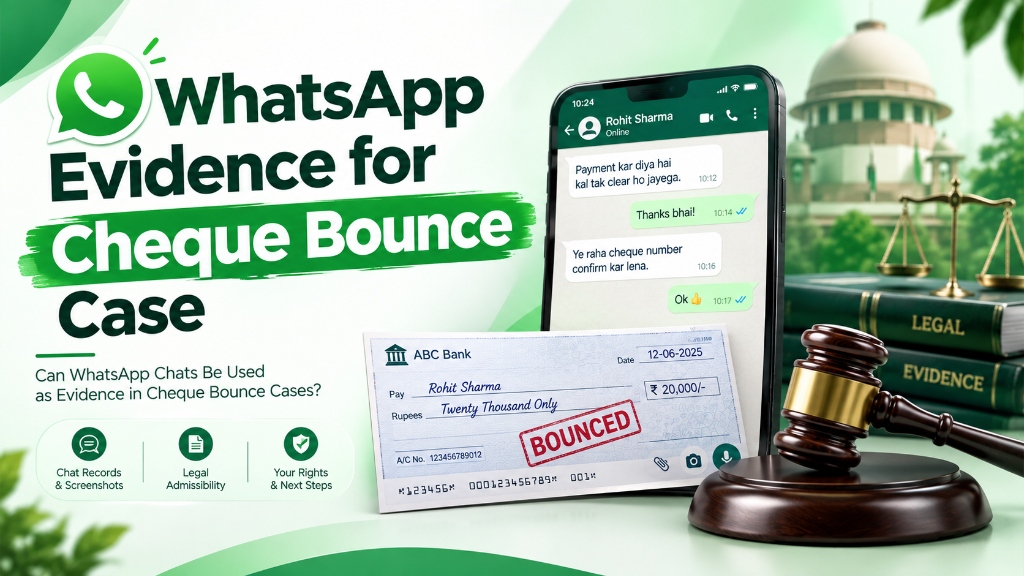
WhatsApp Evidence in Section 138 NI Act Cheque Bounce Cases (2026 Guide)
Home › Blog › WhatsApp Evidence in Section 138 Cheque Bounce Cases
Table of Contents
- Quick Answer: Can WhatsApp Chats and WhatsApp Notices Win a Cheque Bounce Case?
- The Anatomy of a Section 138 Case: Where WhatsApp Fits in the Timeline
- Serving the Statutory Demand Notice via WhatsApp: The 2026 Rulebook
- What the Supreme Court's Satender Kumar Antil (2025) Actually Decided — and What It Did Not
- Proving "Legally Enforceable Debt" Through WhatsApp Admissions
- The Sanjabij Tari (2025) Roadmap: How 138 Trials Actually Run Now
- Section 63 BSA Compliance for WhatsApp Evidence in a 138 Complaint
- Cross-Examination Checklist: The 8 Questions the Defence Will Ask
- Drafting Template: WhatsApp Evidence Affidavit Clause for a 138 Complaint
- 8 Fatal Mistakes That Kill 138 Complaints Built on WhatsApp Evidence
- Case Study: How a WhatsApp Balance Confirmation Broke the "Security Cheque" Defence
- Frequently Asked Questions
- Conclusion & Action Plan
Quick Answer: Can WhatsApp Chats and WhatsApp Notices Win a Cheque Bounce Case?
Yes — on both counts. In 2026, WhatsApp is legally usable at three critical points of a Section 138 NI Act case, and the Supreme Court has made the process faster, not harder:
- The statutory demand notice can be served via WhatsApp. The Allahabad High Court in Rajendra v. State of U.P. (2024:AHC:14247) held that a demand notice sent by email or WhatsApp is a valid notice under Section 138 NI Act if it fulfils the requirements of the Information Technology Act, and that it is deemed served on the date of dispatch itself. The court circulated this direction to every Magistrate in Uttar Pradesh.
- WhatsApp chats can prove the legally enforceable debt. Admissions like "haan bhai, 8.5 lakh ka cheque diya hai, is mahine clear kar dunga" — balance confirmations, repayment promises, loan requests — are exhibited as documentary evidence and routinely demolish the standard "security cheque" defence. They need a Section 63 BSA certificate (formerly Section 65B) to be admissible.
- The court summons itself can be served electronically. The Supreme Court's Sanjabij Tari v. Kishore S. Borcar (2025) guidelines direct Magistrates to serve summons by electronic means including WhatsApp, require complainants to file the accused's WhatsApp number with a verification affidavit, and push QR/UPI payment links into summons so cases settle at the first hearing.
And one clarification you will not find stated properly on most websites: the Supreme Court's 2025 ruling in Satender Kumar Antil v. CBI — often misreported as a "WhatsApp notice ban" — bans WhatsApp service of police appearance notices only. It expressly preserves electronic service of court summons and says nothing against private demand notices between the parties. Section 138 WhatsApp notices remain valid. Section 4 explains this precisely, because the defence will misquote this case at you.
⚡ Facing a bounced cheque right now? Before you even send the demand notice, export the entire chat with the drawer — including the messages where they confirmed the debt and promised payment — and generate a court-ready PDF with a Section 63 BSA certificate and SHA-256 hash in ~5 minutes, for ₹999, entirely in your browser (zero upload). Chat2Evidence → Once the notice goes out, some drawers panic-delete the chat.
The Anatomy of a Section 138 Case: Where WhatsApp Fits in the Timeline
Most 138 complaints die from procedural timing errors, not from weak evidence. Before touching WhatsApp strategy, internalise this timeline — every date below is a hard statutory boundary:
| Stage | Statutory Provision | Time Limit | Where WhatsApp Fits |
|---|---|---|---|
| Cheque presented to bank | Section 138 NI Act | Within the cheque's validity (3 months from the date on the cheque) | — |
| Dishonour + bank memo received | Proviso (a) | — | Photograph/scan the memo the day you receive it |
| Demand notice sent | Proviso (b) | Within 30 days of receiving the return memo | Notice via registered post + WhatsApp/email (dual track) |
| Drawer's payment window | Proviso (c) | 15 days from receipt of notice | The drawer's reply (or silence) on WhatsApp becomes evidence |
| Cause of action arises | Section 138(c) | Day after the 15-day window expires | Non-payment + non-reply = complete cause of action |
| Complaint filed | Section 142(1)(b) | Within 30 days of cause of action (condonable delay is discretionary — never rely on it) | WhatsApp chat export + Section 63 BSA certificate filed as exhibits |
| Cognizance & summons | Sections 142/143 NI Act; BNSS 223/63/64 | — | Sanjabij Tari: electronic summons via WhatsApp now standard |
| Trial | Section 143 (summary trial) | Mandated to be fast; 6-month ethos | Your certified chat evidence is examined |
Three implications most first-time complainants miss:
- The notice clock starts from the day you receive the bank memo — not the date on the memo, and not the date the cheque was presented. Diarise it the hour the memo reaches you.
- "Receipt" of the notice, not "dispatch," starts the 15-day payment window — which is exactly why how you serve the notice (and how you prove service) is a battlefield. This entire guide's notice section exists for this row of the table.
- Silence is now an admission-adjacent fact. Under Sanjabij Tari (2025), the Supreme Court confirmed that the drawer's failure to reply to the statutory notice supports an inference that the dishonour complaint has merit. A WhatsApp notice with blue ticks that was never answered is one of the strongest opening positions a complainant can hold.
🚨 The most common fatal error in Indian cheque bounce litigation: sending the notice late because the parties were "still talking on WhatsApp." Friendly negotiations do not stop the statutory clock. Send the notice on time; keep negotiating after.
Serving the Statutory Demand Notice via WhatsApp: The 2026 Rulebook
The governing law, as it stands in September 2026
For decades, Section 138 demand notices travelled by registered post with acknowledgment due (AD). The law has moved — but unevenly, which is why the dual-track protocol below is the professional standard.
1. The classical default: registered post remains the gold standard.
The Supreme Court in C.C. Alavi Haji v. Palapetti Muhammad (2007) 6 SCC 555 settled that a notice sent by registered post to the correct address of the drawer is deemed served even if the postal endorsement shows "not claimed," "unclaimed," or "refused" — refusal and evasion are treated as conscious avoidance of service. This remains the safest single method.
2. WhatsApp and email notices are now expressly valid.
In Rajendra v. State of U.P. (2024:AHC:14247, decided 25 January 2024), a single judge of the Allahabad High Court — speaking to Magistrates statewide — held:
- A demand notice sent through email or WhatsApp, if it fulfils the requirements of Section 13 of the IT Act, 2000 (electronic records and attribution), is a valid notice under Section 138 NI Act;
- Such a notice is deemed to be served on the date of dispatch itself — cutting off the drawer's ability to stall by simply not "receiving" anything;
- Every 138 complaint filed by registered post should carry the post tracking report, so dishonest drawers cannot plead non-service of the 15-day notice.
3. Blue ticks as proof of knowledge.
Since the Supreme Court's Suo Motu WP(C) No. 3 of 2020 order (10 July 2020) — which permitted service of notices and summons by email, fax and instant messaging services (with a simultaneous email copy where WhatsApp is used) — Indian courts have treated double blue ticks as evidence that the notice was delivered and read. As the then CJI observed during the hearing: where the two blue ticks are present, service is provable under the evidence law. The caveat every practitioner knows: read receipts can be disabled, so blue ticks are strong corroboration, not the sole foundation.
The dual-track protocol (what professionals actually do)
Do not choose between post and WhatsApp. Do both, in this order:
- Day 0: Send the demand notice (PDF, signed, on letterhead if through counsel) by registered post AD / speed post to the drawer's address, and simultaneously by WhatsApp to the drawer's number and email to the drawer's email — the Suo Motu 3/2020 combination.
- Same day: Screenshot is not enough — the WhatsApp conversation containing the sent notice, its delivery ticks, timestamps, and the drawer's number must be preserved as evidence: export the chat immediately, generate the SHA-256 hash, and store it. This thread is Exhibit A of your service case.
- Track the post: download the India Post tracking report showing delivery/refusal, and preserve it.
- Day 15+: if no payment, the cause of action is complete. If the drawer replied on WhatsApp — even with excuses — that reply is evidence of receipt and acknowledgment, and it joins your complaint exhibits.
| Method | Proof of Service | Risk |
|---|---|---|
| Registered post AD only | Tracking report; deemed service on refusal (Alavi Haji) | Slow; drawer evades by not collecting — though deemed-served doctrine covers this |
| WhatsApp only | Delivery/read receipts, deemed served on dispatch (Rajendra) | Blue ticks can be disabled; number attribution can be contested |
| Dual track (post + WhatsApp + email) | Both of the above, mutually reinforcing | None beyond cost of a stamp |
⚡ Why hashing the notice thread matters: The drawer's first move after receiving a demand notice is often to block you or delete the conversation on their end. Your export, hashed on the day you sent the notice, freezes the entire service story — sent, delivered, read, ignored — before they can touch it. Chat2Evidence generates that hash-and-certificate bundle in minutes. Preserve your notice thread →
What the Supreme Court's Satender Kumar Antil (2025) Actually Decided — and What It Did Not
In 2025 you will hear the drawer or their counsel say: "My Lord, the Supreme Court has held WhatsApp notices are illegal — Satender Kumar Antil v. CBI." This misquote is circulating widely, and if you cannot answer it, it can cost you a hearing. Here is the accurate picture.
What the Supreme Court held
In Satender Kumar Antil v. CBI — the order dated 21 January 2025, confirmed on 16 July 2025 (2025 INSC 909) — the Court directed all States and Union Territories to issue standing orders that notices under Section 41-A CrPC / Section 35 BNSS (police notices of appearance in investigation) be served only by the modes prescribed in the Code, and held:
Service of notice through WhatsApp or other electronic modes cannot be considered or recognised as an alternative or substitute to the modes of service recognised and prescribed under the CrPC, 1973 or the BNSS, 2023.
The three limits of that holding — and why your WhatsApp notice survives
| The Distinction | What It Means for Your 138 Case |
|---|---|
| Executive act vs judicial act | The banned item is a police/Investigating Agency notice (an executive act affecting personal liberty under Article 21). The Court itself drew the line: a court summons is a judicial act, governed differently. |
| The BNSS itself permits electronic service of court summons | Sections 63(2) (summons in electronic form with court seal image/digital signature) and 64(2) proviso (electronic service of summons) and 71 (witness summons by electronic communication) of the BNSS, 2023 expressly authorise what the Court refused to invent for police notices. The omission the Court relied on exists in Section 35 BNSS — it does not exist in the summons provisions. |
| Private demand notices are neither | A Section 138 demand notice is sent by a private party, not police and not court. The Allahabad High Court's Rajendra (2024) validity ruling postdates and is unaffected; the Suo Motu 3/2020 digital-service order concerned court service; and Sanjabij Tari (2025) subsequently ordered electronic summons in 138 cases. |
The one-line rebuttal to use in court
"Satender Kumar Antil governs Section 35 BNSS police notices — an executive act. This notice is a private demand notice, expressly upheld in Rajendra v. State of U.P. (2024), and even court summons in Section 138 cases are now directed to be served electronically under the Supreme Court's own Sanjabij Tari guidelines of 2025."
Know this paragraph cold. The defence raises Antil precisely because most complainants have never read it.
🚨 A genuine warning that cuts the other way: Antil does remind everyone that informal digital communication is attackable when authentication is weak. If your only proof of notice is a cropped screenshot with no hash, no certificate, and no number attribution, Antil becomes rhetorically useful to the defence even though it does not govern your notice. Certified, hashed evidence neutralises the rhetoric.
Proving "Legally Enforceable Debt" Through WhatsApp Admissions
Section 138 punishes dishonour of a cheque issued "for the discharge, in whole or in part, of any debt or other liability." The prosecution must establish that a legally enforceable debt or liability existed. Two statutory presumptions do heavy lifting — and WhatsApp evidence decides what remains.
The presumption framework
- Section 118 NI Act presumes a cheque was issued for consideration.
- Section 139 NI Act presumes the cheque was issued for the discharge of a legally enforceable debt or liability — the presumption of law is in the complainant's favour (Rangappa v. Sri Mohan, (2010) 11 SCC 441).
- The presumption is rebuttable: once the accused proves the debt never existed or stood discharged, the burden swings back to the complainant (Basalingappa v. Mudibasappa, (2019) 5 SCC 418). The debt must exist on the date of the cheque (Krishna Janardhan Bhat v. Dattatraya G. Hegde, (2008) 4 SCC 54).
- At the quashing stage, the High Court cannot conduct a roving enquiry into whether the debt existed — the statutory presumption holds until trial (Sri Om Sales v. Abhay Kumar, 2025 SCC OnLine SC 2897).
Where WhatsApp admissions become decisive
The presumptions get the complainant to the doorstep. WhatsApp evidence closes the door — especially against the four standard defences:
| Defence Raised | WhatsApp Evidence That Demolishes It |
|---|---|
| "It was only a security cheque, not for a live debt" | Messages showing the cheque was given against a specific outstanding amount; balance confirmations; the drawer's own reference to the cheque number and amount; payment requests predating the cheque. |
| "The debt was already repaid" | The drawer's post-repayment-period messages acknowledging the balance is still outstanding; absence of any repayment claim in the chat before the memo arrived — and the drawer's silence after the notice (Sanjabij Tari inference). |
| "The cheque was blank/misused/altered" | Chat context showing the transaction, amount negotiations, and delivery of the cheque; the drawer's failure to report loss or misuse to the bank or police. |
| "No debt at all — the cheque was friendly accommodation" | Loan request messages, purpose discussions ("payment for goods delivered on [date]"), invoice references, GST/billing mentions, prior part-payments recorded in chat. |
The message patterns Magistrates actually credit
Not all chat content is equal. In roughly descending order of evidentiary weight in 138 trials:
- Quantified balance confirmations — "total 8,50,000 bacha hai, 5 lakh ka cheque de raha hun" — the single strongest pattern.
- Cheque-specific references — mentioning the cheque number, date, or amount in chat around the issuance date.
- Repayment promises after dishonour — "kal tak ho jayega, thoda time do" sent after the memo — proves debt + knowledge + failure to pay in one message.
- Notice-reply messages — any response after the demand notice (evidence of receipt and acknowledgment).
- Voice notes confirming amounts — powerful, but they need the audio-evidence treatment (see our Section 63 BSA audio guide).
💡 Why this section exists in a cheque bounce article: in defended 138 trials, the fight is almost never about whether the cheque bounced — it is about whether the debt existed. The cheque is paper; the WhatsApp thread is the story of the debt. Trials are won by the party who tells that story with admissible, hash-verified, certified evidence rather than a phone waved around in the witness box.
The Sanjabij Tari (2025) Roadmap: How 138 Trials Actually Run Now
In Sanjabij Tari v. Kishore S. Borcar (2025), the Supreme Court issued comprehensive guidelines to unclog the massive backlog of Section 138 cases. If you are a complainant, this judgment is the single most important procedural development of the decade — and it is built around electronic communication. Here is what changes for you:
1. Electronic service of summons is now the norm, not the exception
- Summons must be served not only by the usual modes but also dasti (through you, the complainant) — and the trial court shall resort to service by electronic means under Sections 64 and 530 BNSS and State rules framed thereunder (such as the Delhi BNSS (Service of Summons and Warrants) Rules, 2025).
- At the time of filing the complaint, you must provide the accused's email address and WhatsApp/messaging details, supported by an affidavit verifying that those particulars genuinely belong to the accused. This is now a filing requirement — and it is precisely the kind of attribution evidence this guide tells you to build anyway.
- You must then file an affidavit of service. A false one exposes you to legal action — another reason your service evidence must be genuine, preserved, and hash-backed rather than improvised.
2. No pre-cognizance summons
Following the Karnataka High Court in Ashok v. Fayaz Aahmad (2025 SCC OnLine Kar 490), the Court confirmed that no summons to the accused is required at the pre-cognizance stage under Section 223 BNSS. The Magistrate takes cognizance on your complaint and supporting documents. A clean, well-annexed complaint therefore matters more than ever — your evidence file is your first hearing.
3. The structured Section 274 BNSS questions
At the first post-cognizance stage, the Magistrate may put the accused the following questions on record (drawn from the Delhi High Court's Rajesh Agarwal template, now standardised):
- Do you admit that the cheque belongs to your account? Yes/No
- Do you admit that the signature on the cheque is yours? Yes/No
- Did you issue/deliver this cheque to the complainant? Yes/No
- Do you admit that you owed liability to the complainant at the time of issuance? Yes/No
- If you deny liability, state the defence: (a) security cheque only; (b) loan repaid; (c) cheque altered/misused; (d) other.
- Do you wish to compound the case at this stage? Yes/No
Why this matters to your WhatsApp evidence: question 4 is where trials are decided. If the accused denies liability at this stage, your WhatsApp balance confirmations and repayment promises become the rebuttal that Basalingappa requires the prosecution to produce. If the accused admits liability here, the case usually compounds or settles on payment. Either way, the chat evidence you preserved in month one determines month six.
4. Interim compensation (Section 143A) — use it early
The guidelines direct courts to consider interim compensation of up to 20% of the cheque amount under Section 143A at the earliest stage. Combined with the QR/UPI payment links that district courts must now build into summons, the structure is explicitly designed so that cases settle at the threshold when the evidence is clean and the liability is obvious. A drawer facing a hash-verified chat admission, a deemed-served WhatsApp notice, and an imminent 143A order has very little room to fight.
What this means in one sentence
The Supreme Court has rebuilt Section 138 procedure around verified digital communication — electronic service, digital particulars affidavits, online payment. Litigants who arrive with certified, hash-verified digital evidence ride this fast track; litigants waving screenshots get converted to the slow lane.
Section 63 BSA Compliance for WhatsApp Evidence in a 138 Complaint
Everything in the authentication guide applies inside a 138 complaint — the certificate is a condition precedent (Arjun Panditrao Khotkar v. Gorantyal, (2020) 7 SCC 1), and bare screenshots get excluded (Dell International Services v. Adeel Feroze, 2024:DHC:4954). But a 138 complaint has its own filing rhythm. Here is how the compliance maps onto the criminal complaint format:
What to file, and where each piece goes
| Document | Where It Goes in the Filing | Notes |
|---|---|---|
| Complaint with Section 138 synopsis (Sanjabij Tari format) | Top of the file, after index | Includes statutory notice particulars — date, mode, tracking number, proof of delivery |
| Complainant's affidavit | With the complaint | States debt, dishonour, notice, non-payment |
| WhatsApp evidence — court-format chronological PDF | Annexed as exhibits (Ex. C-1 onwards) | Paginated, +91 numbers visible, media inline |
| Section 63(4) BSA certificate | With each electronic exhibit | Signed by you as the person in charge of the device; all four limbs completed |
| SHA-256 hash record | Within the certificate + emailed to yourself at preservation | Your integrity alibi against "edited chat" allegations |
| Notice-service evidence bundle | Annexed separately (Ex. series) | WhatsApp export of the notice thread, post tracking report, email copy |
| Bank documents | Annexed | Cheque copy, return memo, account statement |
| Accused's digital-particulars affidavit | With the complaint | Sanjabij Tari requirement — WhatsApp number/email of the accused verified |
| Sealed media (CD/USB) with export ZIP + PDF | At the time of evidence, kept ready | Registry/lab verification of the hash if ordered |
The four-limb certificate, translated to a 138 context
Your Section 63(4) BSA certificate (full template in the authentication guide) must, in a 138 matter, additionally make these points cleanly:
- Identify the record precisely — "WhatsApp conversation between +91-[your number] and +91-[drawer's number] concerning the transaction underlying cheque no. [____] dated [__] for ₹[__], exported on [date]." Linking the exhibit to the cheque number in the certificate is a small detail that defeats "what chat is this even about?" objections.
- Device particulars — your phone's make, model, OS, IMEI; you are the person in charge of that device and the WhatsApp account registered on your number.
- Section 63(2) conditions — the device was regularly used for these communications; the information was fed in the ordinary course; the device operated properly.
- Integrity — the SHA-256 hash of the export generated at preservation; the filed PDF bears the identical hash; nothing altered, deleted, or reordered.
Magistrate-court practicalities
- 138 trials are summary trials by design (Section 143 NI Act; conversion to summons trial requires recorded reasons). That means short evidentiary windows — exhibits filed late get squeezed out. File the certificate with the complaint.
- Evidence of witnesses in the Section 202/225 BNSS inquiry can be taken on affidavit — your affidavit describing export and hashing should be drafted once, correctly, and reused.
- Under Section 251 CrPC / Section 274 BNSS, there is no discharge in a summons case — you will not get a clean exit on a technicality, and neither will the accused. The trial will reach the merits. Your evidence quality is the case.
⚡ The 5-minute filing bundle: Chat2Evidence produces exactly this package from your exported ZIP — chronological court-format PDF with +91 numbers and inline media, auto-drafted Section 63 BSA certificate with the SHA-256 hash printed on it. ₹999, client-side, zero upload. Build your 138 evidence bundle →
Cross-Examination Checklist: The 8 Questions the Defence Will Ask
If you are the complainant witness, the defence has a standard script for attacking WhatsApp evidence in 138 trials. Prepare a truthful one-line answer for each, with the backing proof, before you enter the box.
| # | Question You Will Face | The Proof That Answers It |
|---|---|---|
| 1 | "You fabricated this chat. Anyone can make a fake WhatsApp conversation with free apps." | Certified full export (not screenshots) + SHA-256 hash generated before the complaint + original device available for court inspection. |
| 2 | "This contact name is typed by you. Where is the number?" | The export shows the drawer's +91 number on the thread; the Sanjabij Tari particulars affidavit verifies the number belongs to the accused; prior calls/SMS to the same number corroborate. |
| 3 | "You cropped and stitched these messages to hide the real story." | The export is the complete conversation in unbroken chronological sequence; the hash proves no excision; offer the sealed media for forensic verification. |
| 4 | "The WhatsApp notice was never received. There is no registered post at all." | Dual-track dispatch proof: registered post tracking report (delivery/refusal per Alavi Haji), plus WhatsApp delivery/read receipts deemed served on dispatch per Rajendra (2024), plus email copy per Suo Motu 3/2020. |
| 5 | "The Supreme Court has banned WhatsApp notices — Satender Kumar Antil." | The one-line rebuttal from Section 4: Antil governs Section 35 BNSS police notices only; court summons are electronically serviceable under BNSS 63/64/71; private demand notices are upheld in Rajendra. |
| 6 | "This account was hacked / the phone was with my family member." | Number attribution: SIM registration, the accused's own voice notes, video calls, photos exchanged on the same thread, UPI handles linked to the number. A "hacked" accuser who never reported the hack to WhatsApp, the bank, or the police is cross-examined into the ground on this. |
| 7 | "You sent the notice late / filed the complaint late." | The bank memo date, the postal receipt, the dispatch date — all pre-30-days; the complaint date within the 142(1)(b) window. (If you were actually late, no checklist saves you — see Mistake 2 below.) |
| 8 | "There was no legally enforceable debt — this was a friendly/security cheque." | The chat admissions table from Section 5: quantified balance confirmations, cheque-number references, post-dishonour repayment promises, plus silence after the notice inviting the Sanjabij Tari inference. |
🚨 The same warning as in every honest guide: these answers must be true. The checklist protects genuine evidence. Deploying it over fabricated evidence converts a Section 138 complaint into exposure under the false-evidence and forgery provisions of the BSA 2023 and BNS 2023.
Drafting Template: WhatsApp Evidence Affidavit Clause for a 138 Complaint
Insert (adapted to your facts, and reviewed by your advocate) into your complainant affidavit or the affidavit accompanying your electronic exhibits:
ANNEXURE AFFIDAVIT — ELECTRONIC EVIDENCE (WHATSAPP RECORDS)

I, [FULL NAME], [age], [occupation], resident of [address], do hereby solemnly affirm and declare as follows:

1. I am the complainant in the above complaint and am the person in charge of the mobile
   device and the WhatsApp account registered on mobile number +91-[MY NUMBER], which
   number has been registered in my name since [month/year].

2. The electronic record annexed herewith as Exhibit [C-__] is a true and complete export of
   the WhatsApp conversation between +91-[MY NUMBER] and +91-[ACCUSED NUMBER] concerning
   the transaction underlying cheque no. [____] dated [__] for Rs. [____], exported by me
   on [DATE] using the native "Export Chat" function of WhatsApp with media included. The
   export has not been altered, added to, deleted from, or reordered in any manner.

3. The said conversation contains admissions by the accused acknowledging the said debt,
   including [e.g., a message dated __ confirming a balance of Rs. __ / a message dated __
   promising payment of the said cheque amount], which messages were sent by the accused
   from the said number and received by me in the ordinary course.

4. The device used was a [make/model], IMEI [____], running [OS version]. The device was
   regularly used by me for the said communications, was operating properly throughout,
   and the record is a true reproduction of the information so received.

5. On [DATE], I computed the SHA-256 hash of the exported record as:
   [64-CHARACTER HASH]
   The same hash was communicated by me to my own email address [email] on the same date,
   and the exhibit filed herewith bears the identical hash, as verifiable by any party.

6. On [DATE], I caused a demand notice under Section 138 of the NI Act to be dispatched
   to the accused by registered post (receipt no. [____], tracking no. [____]) and
   simultaneously to the accused's WhatsApp number +91-[ACCUSED NUMBER] and email
   [email]. The postal tracking report and the record of electronic dispatch are annexed
   as Exhibit [C-__]. The accused did not make payment within fifteen days of service.

Verified at [City] on this [__] day of [Month], 2026.

[Signature]
[Full Name]
💡 Why the hash paragraph earns its place: defence counsel in 138 cases has one reliable gambit — delay by challenging the chat. A hash paragraph converts that gambit from a three-hearing argument into a thirty-second verification. Magistrates running summary trials under the Sanjabij Tari fast track reward complainants who make the court's job this easy.
8 Fatal Mistakes That Kill 138 Complaints Built on WhatsApp Evidence
🚨 Mistake 1 — Sending the demand notice by WhatsApp alone, casually. WhatsApp-only service is legally defensible after Rajendra — but only if the notice itself is a proper document (complete, signed/drafted as a demand, correct amount and cheque details) and you preserve dispatch proof. A half-message like "bhai cheque bounce ho gaya, paise bhejo" is not a demand notice for anyone. Draft it properly; send it dual-track; preserve everything.
🚨 Mistake 2 — Missing the statutory clocks. Notice beyond 30 days of the memo; complaint beyond 30 days of cause of action. Condonation of delay under Section 142(1)(b) is discretionary and slow. The clocks do not pause because the parties were negotiating on WhatsApp. Diarise all three dates the day the cheque bounces.
🚨 Mistake 3 — Filing chats without a Section 63 BSA certificate. After Arjun Panditrao and Dell v. Adeel Feroze, uncertified chat printouts in a 138 complaint are objection bait — and under the Sanjabij Tari no-pre-cognizance-summons regime, your complaint documents are the first hearing. File the certificate with the complaint, not in reply to an objection.
🚨 Mistake 4 — Letting the drawer delete first. The moment a demand notice lands, experienced drawers delete the conversation, block the complainant, or enable disappearing messages. Export and hash the full chat before you send the notice — or at latest the same day. Preservation is a race, and you started it.
🚨 Mistake 5 — Relying on contact names and screenshots. "Ramesh Builders" proves nothing; +91-98XXXXXX10 tied to SIM records proves identity. Cropped screenshots of three messages prove less than a certified 400-page export proving the whole relationship. Exhibits must show numbers, not names, and completeness, not selection.
🚨 Mistake 6 — Misreading Satender Kumar Antil — in either direction. Two errors: (a) believing WhatsApp notices are banned and reverting to post-only service while losing the speed and deemed-service advantages of Rajendra; or (b) ignoring Antil rhetorically and walking in with weak, unauthenticated digital proof. Know exactly what the case holds (Section 4).
🚨 Mistake 7 — Not asking for Section 143A interim compensation. The 2025 guidelines tell courts to consider it early. Complainants who forget to seek interim compensation leave up to 20% of the cheque amount on the table for months — and lose a powerful settlement lever, because a drawer who has already paid 20% thinks very hard about fighting on.
🚨 Mistake 8 — Treating the WhatsApp thread and the 138 complaint as separate projects. The strongest 138 files tell one story: chat shows the debt born and growing → cheque issued against it → chat shows it bouncing → notice sent and read on WhatsApp → silence or excuses → complaint. Build the evidence file as that single narrative from day one, not as exhibits assembled in panic the week before filing.
Case Study: How a WhatsApp Balance Confirmation Broke the "Security Cheque" Defence
A composite case study based on a common Section 138 pattern in metropolitan Magistrate courts. Names and figures are illustrative; the legal mechanics are exactly as described.
The dispute: Farid Ahmed, a building-materials supplier in Lucknow, supplied goods worth ₹11.4 lakh to a contractor over five months. Payments stalled. The contractor issued two cheques totalling ₹6.8 lakh. Both bounced — "insufficiency of funds." On the phone, the contractor was all reassurance; on WhatsApp, he had confirmed everything in writing.
What Farid had, instinctively:
- A WhatsApp thread of 19 months, including a message from the contractor: "6.8 ka 2 cheque diye hain, baaki 4.6 bhi clear ho jayega is quarter mein. Tension mat lo." — sent two days after the cheques.
- The cheque return memos, and his bank statement.
What Farid had not done:
- He had no hash, no certificate, no export. When his advocate sent the demand notice, the contractor — predictably — stopped replying, then blocked him. His new lawyer also raised Satender Kumar Antil at the first hearing, claiming the WhatsApp notice was "illegal service."
The fix (one adjournment):
- The advocate produced the rebuttal: Rajendra (2024) for WhatsApp-notice validity, the BNSS 63/64/71 distinction from Antil itself, and the Sanjabij Tari guidelines endorsing electronic service in 138 cases. The service objection collapsed on the spot.
- The chat was exported from the original phone (which had never been reset or reinstalled), converted into a chronological court-format PDF with +91 numbers visible, certified under Section 63(4) BSA, and hashed. The pre-suit message about the two cheques sat at a paginated, exhibit-labelled page.
- An application under Section 143A sought 20% interim compensation. Facing a hash-verified admission tying the cheques to a live debt — the exact antidote to the "security cheque" defence — the contractor compounded under Section 147 within six weeks: full cheque amounts plus costs.
The three transferable lessons:
- The admission wins; the certificate admits it. Farid's message was always devastating. It only became usable once it was certified, hashed, and formatted to survive objection.
- The service objection is now a trap for the uninformed. Any defence counsel still quoting Antil against a private WhatsApp demand notice is quoting it wrong — and pays for it in credibility.
- Speed is strategy. Six weeks from objection to compounding happened because the evidence file was clean enough to fit the Sanjabij Tari fast track. Messy files get the slow lane, and the slow lane is where drawers win.
⚡ The ₹999 parallel: export → chronological PDF → Section 63 BSA certificate → SHA-256 hash, in about 5 minutes, zero upload, before the drawer even knows a complaint is coming. Chat2Evidence →
Frequently Asked Questions
1. Can I send the Section 138 demand notice only via WhatsApp, without registered post?
The Allahabad High Court in Rajendra v. State of U.P. (2024) held that an email or WhatsApp notice satisfying Section 13 of the IT Act is valid under Section 138 and is deemed served on the date of dispatch. That said, the professional standard is dual-track: registered post AD plus WhatsApp and email. Registered post gives you the Alavi Haji deemed-service doctrine on refusal or non-collection; WhatsApp gives you instant deemed service and read receipts. Relying on one channel hands the defence a service objection it does not deserve.
2. Does the Supreme Court's Satender Kumar Antil judgment (2025) make WhatsApp notices illegal?
No. Antil holds that police appearance notices under Section 41-A CrPC / Section 35 BNSS cannot be served electronically — an executive act affecting liberty. The same judgment expressly preserves electronic service of court summons (BNSS Sections 63, 64, 71), and it says nothing about private demand notices between parties, which Rajendra (2024) upholds. See Section 4 for the precise distinction and the one-line court rebuttal.
3. What is the exact time limit for the notice and the complaint?
The demand notice must be sent within 30 days of receiving the bank's cheque return memo. The drawer then has 15 days from receipt of the notice to pay. If they default, the complaint must be filed within 30 days of the cause of action (the day after the 15-day window closes). The limitation can be condoned only at the court's discretion with sufficient cause — build your case around the default timeline, not around condonation.
4. Can WhatsApp chats really prove the debt when the accused says "security cheque"?
Yes — this is where WhatsApp evidence is most decisive. Quantified balance confirmations, references to the specific cheque number and amount, and post-dishonour repayment promises rebut the security-cheque defence directly. The statutory presumptions under Sections 118/139 NI Act already favour you (Rangappa); when the accused produces a rebuttal, your certified chat admissions are the prosecution's answer (Basalingappa burden-swing framework).
5. Do I need to produce my phone in court for the WhatsApp evidence?
Not necessarily. Under Arjun Panditrao Khotkar (2020) you have two routes: produce the original device and testify, or file a certified record under Section 63 BSA with the certificate. The certified-record route is the norm in 138 trials — but keep the phone intact and ready in case the Magistrate directs its production.
6. What if the drawer replies to the notice with excuses instead of paying?
A reply is still valuable evidence — it proves receipt of the notice (defeating service objections) and usually contains admissions ("thoda time do, paise aa jayenge"). Preserve it exactly like the rest of the thread: export, hash, certify. Under Sanjabij Tari, the drawer's failure to reply supports an inference of merit in the complaint; a reply full of payment excuses is not much better for them.
7. How do I prove the WhatsApp number belongs to the accused?
Through attribution evidence: your Sanjabij Tari particulars affidavit verifying the number, the chat thread itself (the accused's voice notes, photos, and personal details are hard to fake), call logs and SMS to the same number, UPI handles linked to it, and — where the case justifies it — application to summon the telecom subscriber records (CAF). A number used for months of business conversation is rarely seriously contestable.
8. What is interim compensation and should I ask for it?
Under Section 143A, the Magistrate can order the drawer to pay you up to 20% of the cheque amount as interim compensation, typically once the accused pleads not guilty. If the accused is acquitted, it is refunded with interest. The 2025 Sanjabij Tari guidelines direct courts to consider it early. Almost always yes — seek it; it creates immediate financial pressure and strongly motivates compounding.
9. Which court should I file the complaint in?
For account payee cheques presented through a bank, jurisdiction lies where your bank branch (payee's home branch) is situated — confirmed for the post-2015 amendment position in Jai Balaji Industries v. Heg Ltd. (2025). For other presentation modes, the K. Bhaskaran (1999) grounds can still operate. Filing in the wrong court wastes months; verify before filing.
10. Can I use WhatsApp evidence if the cheques were issued by a company?
Yes — 138 complaints against companies name the company and the persons in charge (Sections 141 NI Act vicarious liability; the Sanjabij Tari synopsis format asks for exactly these particulars). WhatsApp chats with directors or authorised managers work the same way, and agency questions ("was this manager authorised?") are answered by the chat itself — authorised people discussing company dues in writing is powerful proof.
Conclusion & Action Plan
A bounced cheque case in 2026 is won in three files: the notice file (served dual-track, deemed served, preserved), the debt file (the WhatsApp thread telling the story of the liability, certified and hashed), and the procedure file (a Sanjabij Tari-compliant complaint that rides the fast track instead of choking on objections). WhatsApp evidence is no longer an exotic extra in Section 138 litigation — the Supreme Court has rebuilt the procedure around electronic communication, and the litigants who thrive are the ones whose digital evidence arrives certified, hash-verified, and impossible to stall.
Your action plan, in order:
- Today (before anything else): Export the full chat with the drawer — with media — and generate the SHA-256 hash. Do this before sending any notice, because a notice changes the drawer's behaviour permanently.
- This week: Send the demand notice dual-track (registered post AD + WhatsApp + email), then export and hash the notice thread itself. Diarise the 30-day and 15-day clocks.
- Before filing: Assemble the single-narrative evidence file — chat PDF with +91 numbers and inline media, Section 63(4) BSA certificate, hash record, notice-service bundle, bank documents, and the particulars affidavit.
- At filing: Use the Sanjabij Tari synopsis format, seek Section 143A interim compensation, and file the accused's verified WhatsApp number for electronic service of summons.
Your three options
| Option | What You Get | Best If |
|---|---|---|
| 1. Do it yourself (Free) | Manual export, self-hashing, self-drafted certificate using this guide's templates | Small amounts, ample time, and a careful advocate |
| 2. Chat2Evidence — ₹999 (Recommended) | Court-ready chronological PDF + auto Section 63 BSA certificate + SHA-256 hash in ~5 minutes, 100% in-browser (zero upload, full confidentiality) | You want the evidence file unimpeachable today, before the drawer deletes, blocks, or lies |
| 3. Private forensic lab (₹15,000–₹50,000) | Full device imaging, examiner report and testimony | High-value disputes where the other side has already hired forensics |
For the overwhelming majority of Section 138 matters — supplier dues, loan recoveries, rent, professional fees — Option 2 delivers Option 3-grade evidentiary hygiene at a price lower than one hearing's travel costs.
⚡ Turn your bounced-cheque WhatsApp thread into court-ready evidence in 5 minutes — ₹999, zero upload, Section 63 BSA certificate and SHA-256 hash included. India's only client-side WhatsApp-to-court-evidence converter. Your chats never leave your phone.
Related Guides
- How to Authenticate WhatsApp Screenshots for Court Submission — the full Section 63 BSA authentication protocol this article builds on
- How to Export WhatsApp Chat for Court (Step-by-Step) — the native export walkthrough
- Preserve WhatsApp Evidence Before Filing a Case — the emergency preservation protocol
- WhatsApp Audio Transcripts & Voice Notes under Section 63 BSA — when the admission is a voice note
- Are WhatsApp Chats Valid in Court in India? — the full admissibility framework
Disclaimer: This guide is legal information, not legal advice, and does not create an advocate-client relationship. Statutes and case law are stated as of September 2026. Consult a qualified advocate for your specific matter.