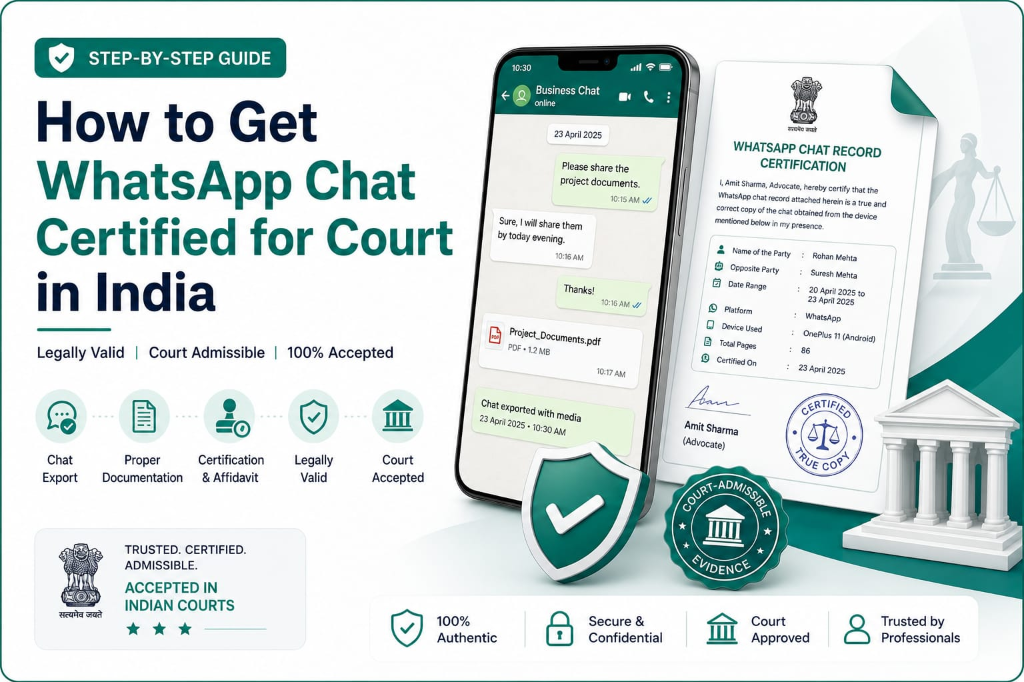
How to Get WhatsApp Chat Certified for Court in India: The Section 63 BSA Certificate Guide (2026)
You know the law. You know your evidence is real. You know the one thing standing between your WhatsApp chat and the judge's desk is a single piece of paper.
That piece of paper is the Section 63 BSA certificate — and without it, your evidence is worthless. Not weak. Not questionable. Worthless. The Delhi High Court in Dell International Services v. Adeel Feroze made it brutally clear: "WhatsApp conversations cannot be read as evidence without a proper certificate as mandated under the Evidence Act." The Supreme Court in Arjun Panditrao Khotkar called the certificate a "condition precedent" — meaning the court is bound by law to reject your evidence if the certificate is missing.
No certificate = No evidence. Period.
But here's the problem nobody tells you: Getting this certificate is not simple. The Bharatiya Sakshya Adhiniyam, 2023 prescribes a two-part certificate with a prescribed format in the Schedule. It requires dual signatures — one from you (the device owner) and one from an expert. It requires a SHA-256 hash value that most people have never heard of. And if you get even one field wrong, the opposite party's lawyer will object — and win.
This guide will show you exactly how to get your WhatsApp chat certified for court in India. The manual way (so you understand what you're up against). The legal requirements (so you know what the certificate must contain). And the instant way — how to get a legally valid, court-ready Section 63 BSA certificate in under 5 minutes.
⚖️ Why the Certificate is Non-Negotiable: The Legal Reality
Before we talk about HOW to get the certificate, let's be crystal clear about WHY you need it.
Under the Bharatiya Sakshya Adhiniyam, 2023 (which replaced the Indian Evidence Act, 1872 from July 1, 2024), Section 63 governs the admissibility of electronic records. Section 63(4) mandates that any electronic record submitted as secondary evidence (printouts, PDFs, screenshots, CDs) must be accompanied by a certificate.
This is not a suggestion. It is not a "nice to have." It is a mandatory condition precedent.
What the Supreme Court has said:
- In Anvar P.V. v. P.K. Basheer (2014): The certificate is a sine qua non (essential condition) for electronic evidence. Without it, the evidence is inadmissible.
- In Arjun Panditrao Khotkar v. Kailash Gorantyal (2020): The certificate is mandatory for all electronic records. The court cannot relax this requirement.
- In Ravinder Singh v. State of Punjab (2022): Oral evidence cannot substitute for the certificate.
What the Delhi High Court has said:
- In Dell International Services v. Adeel Feroze (2024): WhatsApp screenshots without a certificate are inadmissible — even if nobody disputes their genuineness.
The message from every court in India is the same: No certificate, no case. The certificate is the gatekeeper. Without it, your evidence never enters the courtroom.
📜 The Section 63 BSA Certificate: What It Actually Is
The Section 63 BSA certificate is not a generic "this is true" statement. It is a legally prescribed document with a specific format, specific content, and specific signatories. The format is set out in the Schedule to the Bharatiya Sakshya Adhiniyam, 2023 (headed "See Section 63(4)(c)").
The Two-Part Structure
The BSA introduced a two-part certificate — a major change from the old single-signatory Section 65B certificate. This is what trips up most litigants.
Part A: The Device Owner's Declaration
Who signs: The person in charge of the device — YOU (if it's your phone).
What it must contain:
- Your Identification
- Full name
- Address
- Contact details
- Device Identification
- Phone make and model (e.g., "Samsung Galaxy S24 Ultra")
- Operating system and version (e.g., "Android 14")
- Your phone number in international format (e.g., "+91-9876543210")
- IMEI number (if available)
- Electronic Record Description
- Exact description of the chat (e.g., "WhatsApp chat between +91-9876543210 and +91-9123456789 from January 1, 2025 to June 30, 2025")
- Date range of the chat
- Number of messages (approximate)
- Whether media is included
- Functioning Assurance
- Declaration that the device was functioning properly during the period the chat was created
- Declaration that the device was in regular use
- Declaration that the information was fed into the device in the ordinary course of activities
- Ownership Declaration
- Declaration that you are the lawful owner/user of the device
- Declaration that you have lawful control over the device
- Signature & Date
- Your signature
- Date of signing
- Place of signing
⚠️ Mistake #1: Many litigants write a generic affidavit saying "I certify this chat is true." That is NOT a Section 63 BSA certificate. The certificate must follow the prescribed format in the Schedule. A generic affidavit will be rejected.
Part B: The Expert's Verification
Who signs: An expert who can verify the integrity of the electronic record.
What it must contain:
- Expert's Identification
- Full name
- Qualifications (degree, certifications, experience)
- Professional designation
- Contact details
- Electronic Record Description
- Same description as Part A
- Reference to the specific file being certified
- Hash Value (SHA-256)
- The exact SHA-256 hash value of the exported chat file
- This is a 64-character alphanumeric string that acts as a digital fingerprint
- Declaration of the algorithm used (must be SHA-256 — older algorithms like MD5 or SHA-1 are considered weak)
- Integrity Assurance
- Declaration that the electronic record has not been altered or tampered with
- Declaration that the hash value corresponds to the original exported file
- Declaration that the record accurately reproduces the original information
- Processing Details (if applicable)
- If the data was processed by an intermediary (e.g., a forensic lab), details of that processing
- Declaration that the processing did not alter the data
- Signature & Date
- Expert's signature
- Date of signing
- Place of signing
- Expert's stamp/seal (if applicable)
⚠️ Mistake #2: Many litigants think they can sign both parts themselves. While recent High Court authority (including Andhra Pradesh HC) supports self-certification for chats on your own device, the two-part structure is still mandatory. You cannot simply write one paragraph and call it a certificate. The format must comply with the Schedule.
🔐 What is a SHA-256 Hash Value (And Why You Can't Skip It)
The SHA-256 hash value is the technical backbone of the Section 63 BSA certificate. Without it, your certificate is incomplete — and vulnerable to objection.
What It Is:
A SHA-256 hash is a 64-character alphanumeric string that acts as a unique digital fingerprint of your exported chat file. It is generated using a cryptographic algorithm (SHA-256) that processes every byte of your file and produces a unique identifier.
Example of a SHA-256 hash:
e3b0c44298fc1c149afbf4c8996fb92427ae41e4649b934ca495991b7852b855How It Works:
- When you export your WhatsApp chat, you generate a SHA-256 hash of the exported file
- This hash is recorded in Part B of the certificate
- If even one character in the file is changed after export (edited, deleted, reformatted), the hash changes completely
- The court (or a forensic expert) can independently verify the hash to confirm the file is exactly as exported
Why Courts Demand It:
- Tamper-proof verification: The hash proves the file has not been altered
- Chain of custody: It creates an unbreakable link between the exported file and the certified file
- Independent verification: Any forensic expert can verify the hash without access to your phone
- Modern standard: SHA-256 is the globally accepted standard for digital evidence integrity
⚠️ Mistake #3: Using MD5 or SHA-1 instead of SHA-256. These older algorithms are considered cryptographically weak. A careful court (or the opposite party's expert) may object that the hash is not sufficiently secure. Always use SHA-256.
⚠️ Mistake #4: Generating the hash AFTER formatting or editing the file. The hash must be generated from the original exported file — not from a Word document, not from a reformatted PDF, not from a printed-and-scanned version. If the hash doesn't match the file you submit, the certificate is invalid.
🛠️ The Manual Way: How to Get a Section 63 BSA Certificate Yourself
If you want to prepare the certificate yourself, here is the complete process. We are showing you this so you understand exactly why most people get it wrong — and why doing it manually is risky, time-consuming, and expensive.
Step 1: Export Your WhatsApp Chat
On Android:
- Open the chat → Tap three dots (⋮) → More → Export Chat
- Choose "Without Media" or "Include Media"
- Save the .txt file (or .zip if media is included)
On iPhone:
- Open the chat → Tap contact name → Export Chat
- Choose "Attach Media" or "Without Media"
- Save the .zip file
⚠️ Critical: Do NOT open, edit, or reformat the exported file before generating the hash. Any change — even opening it in Word and saving it — changes the file and invalidates the hash.
Step 2: Generate the SHA-256 Hash Value
You need a tool to generate the hash. Here are your options:
Option A: Command Line (Technical)
- Windows: Open Command Prompt → Type:
certutil -hashfile "filename.txt" SHA256 - Mac/Linux: Open Terminal → Type:
shasum -a 256 filename.txt
Option B: Online Hash Generators (Risky)
- Upload your file to an online SHA-256 generator
- ⚠️ Security risk: You're uploading personal chat data to a third-party website
- ⚠️ Reliability risk: Some online tools use weak algorithms or incorrect implementations
Option C: Forensic Software (Expensive)
- Tools like EnCase, FTK, or Cellebrite generate hashes
- Cost: ₹50,000–₹2,00,000+ for professional licenses
- Requires training to use properly
⚠️ Problem: Most litigants don't know how to use command-line tools, don't trust online generators with personal data, and can't afford forensic software. This is where the process breaks down.
Step 3: Find an Expert for Part B
This is the biggest hurdle for most litigants.
Who qualifies as an "expert" under Section 63?
The BSA does not define "expert" precisely, but courts generally accept:
- Cyber forensic experts with recognized certifications
- IT professionals with relevant qualifications
- Digital evidence specialists
- In some cases, the party themselves (for self-certification on their own device)
Where to find an expert:
- Cyber forensic labs (₹5,000–₹25,000 per certificate)
- Private investigators with digital forensics capability
- IT consultants with legal experience
- Some law firms have in-house technical experts
What the expert needs from you:
- The original exported file
- The SHA-256 hash value
- Details of the device (make, model, OS version)
- Your signed Part A declaration
⚠️ Problem: Finding a qualified expert can take days or weeks. They may be expensive. They may be unavailable for your court date. And if their qualifications are challenged by the opposite party, you may need to produce their CV and credentials in court.
Step 4: Draft the Certificate in the Prescribed Format
You must draft the certificate following the Schedule to the BSA, 2023. The format is not optional.
The certificate must include:
- Heading: "Certificate under Section 63(4) of the Bharatiya Sakshya Adhiniyam, 2023"
- Part A (as described above)
- Part B (as described above)
- Both parts must be on the same document or clearly linked
- Page numbers if multi-page
- Date and place of signing for both parts
⚠️ Problem: Most litigants don't have access to the exact Schedule format. They draft something that looks "official" but doesn't match the prescribed format. The opposite party's lawyer objects: "This certificate does not comply with the Schedule to the BSA." The judge agrees. Your evidence is rejected.
Step 5: Get Both Parts Signed
Part A: You sign as the device owner.
Part B: The expert signs as the verifier.
⚠️ Problem: If the expert is unavailable on your court date, you may not be able to produce them for cross-examination. Some courts require the expert to be present to verify their signature. If they can't appear, the certificate may be challenged.
Step 6: File the Certificate with Your Evidence
The certificate must be filed:
- At the admissibility stage (when the evidence is formally tendered)
- Along with the electronic record (not separately, not later)
- As part of the same exhibit (e.g., "Exhibit P-1 along with Certificate P-1A")
⚠️ Problem: Many litigants file the evidence first and "add the certificate later." This is fatal. The opposite party objects immediately. The judge sustains the objection. Your evidence is rejected before the certificate ever reaches the file.
💀 Why the Manual Certificate Process Fails in Real Courts
Let's look at what actually happens when people try to get the certificate themselves:
Case 1: The Wrong Algorithm
A businessman in a commercial dispute generated an MD5 hash for his WhatsApp export. The opposite party's forensic expert objected: "MD5 is cryptographically broken and collision-vulnerable. The hash is unreliable." The court agreed and gave reduced weight to the evidence. The businessman lost ₹15 lakhs in the arbitration.
Case 2: The Missing Expert
A woman in a divorce case drafted her own certificate with a single signature. She claimed she was the "expert" because it was her own phone. The husband's lawyer objected: "The BSA requires dual signatures — one from the person in charge and one from an expert. This certificate is defective." The court sustained the objection. The evidence was excluded.
Case 3: The Hash Mismatch
A litigant generated the hash from the original export but then reformatted the chat in Word before printing. The hash in the certificate no longer matched the printed file. The opposite party's lawyer discovered the mismatch and claimed the evidence was tampered with. The court rejected the entire evidence package.
Case 4: The Generic Affidavit
A defendant in a cheque bounce case submitted a notarized affidavit saying "I certify that these WhatsApp messages are true and accurate." The complainant's lawyer objected: "This is not a Section 63 BSA certificate. It does not identify the device, describe the record, or contain a hash value. It is inadmissible." The court agreed. The defense lost.
The pattern is clear: Getting the certificate right is not just difficult — it's dangerous. One error in format, algorithm, signatory, or hash matching, and your evidence is gone.
🚀 The Instant Way: Get Your Section 63 BSA Certificate in 5 Minutes
You don't have to do this alone.
Chat2Evidence.in is India's only tool that automatically generates a legally valid, court-ready Section 63 BSA certificate — complete with both Part A and Part B, SHA-256 hash value, and full compliance with the Schedule to the Bharatiya Sakshya Adhiniyam, 2023.
How It Works:
Step 1: Export your WhatsApp chat (30 seconds)
Step 2: Upload the exported file to chat2evidence.in
Step 3: Our system automatically:
- ✅ Extracts device metadata (make, model, OS version, phone number)
- ✅ Generates the SHA-256 hash value from the original exported file
- ✅ Creates Part A of the certificate (device owner declaration) — ready for your signature
- ✅ Creates Part B of the certificate (expert verification) — with hash value and integrity assurance
- ✅ Formats everything according to the Schedule to the BSA, 2023
- ✅ Produces a complete, court-ready PDF with the certificate attached
Step 4: Download your evidence package
Step 5: Sign Part A, have your lawyer (or a qualified expert) sign Part B, and file it with the court
Total time: 5 minutes.
Total cost: ₹999.
📊 Manual Certificate vs. Chat2Evidence.in: The Comparison
| Certificate Requirement | Manual Preparation | Chat2Evidence.in |
|---|---|---|
| Export chat | You do it | ✅ You do it (30 seconds) |
| Generate SHA-256 hash | Command line / online tool / forensic software | ✅ Auto-generated from original file |
| Draft Part A (device owner) | You must draft yourself | ✅ Auto-generated with device metadata |
| Draft Part B (expert verification) | You must find an expert | ✅ Auto-generated with hash + integrity assurance |
| Format compliance with BSA Schedule | Risk of non-compliance | ✅ Prescribed format built-in |
| Dual signature structure | Risk of missing one part | ✅ Both parts included |
| Hash algorithm (SHA-256) | Risk of using MD5/SHA-1 | ✅ SHA-256 guaranteed |
| Hash-file matching | Risk of mismatch after formatting | ✅ Hash generated from original export, never altered |
| Expert availability | Days/weeks to find one | ✅ Instant — no waiting |
| Expert cost | ₹5,000–₹25,000 | ✅ Included in ₹999 |
| Time to prepare | 3-7 days | ✅ 5 minutes |
| Risk of rejection | HIGH | ✅ MINIMAL |
🏛️ Built for Indian Law: Full BSA 2023 Compliance
The Bharatiya Sakshya Adhiniyam, 2023 introduced significant changes from the old Indian Evidence Act. Chat2Evidence.in is built specifically for these changes:
What's New in Section 63 BSA (vs. Old Section 65B IEA):
| Feature | Old Section 65B IEA | New Section 63 BSA |
|---|---|---|
| Device scope | Primarily "computer" | "Computer or any communication device" — explicitly covers smartphones |
| Certificate format | No prescribed format | Mandatory prescribed two-part format in the Schedule |
| Signatories | Single signature | Dual signatures required (person in charge + expert) |
| Intermediary processing | Not mentioned | Explicitly recognized under Section 63(3)(e) |
| Submission timing | Generally at admissibility | "Shall be submitted along with the electronic record at each instance" |
Chat2Evidence.in automatically complies with all these requirements.
🧠 The Psychology of the Certificate: Why It Wins Cases Before They're Heard
Let's understand what happens when the judge sees your certificate:
Scenario A: Generic Affidavit
The judge sees a one-page notarized affidavit saying "I certify this is true." No device details. No hash value. No expert signature. The judge thinks: "This person doesn't understand the law. If they can't get the certificate right, how do I know they got the evidence right?" The opposite party objects. The judge sustains. Your evidence is rejected.
Scenario B: Properly Formatted Two-Part Certificate with SHA-256 Hash
The judge sees a professionally formatted certificate with:
- Part A: Detailed device identification, functioning assurance, owner declaration
- Part B: Expert verification, SHA-256 hash value, integrity assurance
- Both parts signed and dated
- Format matching the Schedule to the BSA
The judge thinks: "This evidence has been prepared by someone who understands the law. The technical details are precise. The hash value proves integrity. This evidence is reliable." The opposite party looks for objections but finds none. The evidence is admitted.
The certificate is not just a legal requirement. It is a signal to the court that you are serious, organized, and credible.
When you submit evidence through Chat2Evidence.in, you are submitting:
- ✅ A certificate in the exact format prescribed by the BSA Schedule
- ✅ A SHA-256 hash that proves cryptographic integrity
- ✅ Both Part A and Part B, properly structured
- ✅ Device metadata extracted automatically from the export
- ✅ A document that looks like it was prepared by a forensic expert
The judge sees professionalism before reading a single word. That's the win.
❓ Frequently Asked Questions
How do I get a certificate for WhatsApp chat evidence in court?
You need a Section 63 BSA certificate in the two-part format prescribed in the Schedule to the Bharatiya Sakshya Adhiniyam, 2023. Part A is signed by you (the device owner) and includes device details and a functioning assurance. Part B is signed by an expert and includes a SHA-256 hash value and an integrity assurance. Both parts must be filed along with the electronic record at the admissibility stage. Chat2Evidence.in automatically generates both parts in the correct format.
What is the format of a Section 63 BSA certificate for WhatsApp chat?
The certificate has a mandatory two-part format set out in the Schedule to the BSA, 2023:
Part A (signed by the person in charge of the device):
- Your name, address, and contact details
- Device make, model, OS version, and phone number
- Description of the electronic record (chat details, date range)
- Declaration that the device was functioning properly and in regular use
- Declaration of lawful ownership/control
- Your signature, date, and place
Part B (signed by an expert):
- Expert's name, qualifications, and contact details
- Description of the electronic record
- SHA-256 hash value of the exported file
- Declaration that the record has not been altered or tampered with
- Declaration that the hash corresponds to the original file
- Expert's signature, date, place, and seal
Can I sign the Section 63 certificate myself?
Part A — YES. You sign Part A as the person in charge of the device. Recent High Court authority (including Andhra Pradesh HC) supports self-certification for WhatsApp messages on your own device.
Part B — IT DEPENDS. Part B requires an expert's verification and signature. While some courts accept the party themselves as the "expert" for their own device (especially in straightforward cases), the safer route is to have a qualified expert sign Part B. Chat2Evidence.in generates Part B with all technical details (hash value, integrity assurance) — your lawyer or a qualified expert can then review and sign it.
What is a SHA-256 hash and how do I generate it?
A SHA-256 hash is a 64-character digital fingerprint of your exported chat file. It proves that the file has not been altered since export. You can generate it using:
- Command line tools (Windows:
certutil -hashfile, Mac/Linux:shasum) - Online hash generators (security risk for personal data)
- Forensic software (expensive)
- Chat2Evidence.in (auto-generated from your original export — safest and fastest)
What happens if I submit WhatsApp evidence without the Section 63 certificate?
The opposite party will object under Section 63 BSA. The judge is bound by law to reject the evidence. It cannot be read, relied upon, or used for cross-examination. Your evidence becomes worthless — even if it's 100% genuine. This is exactly what happened in Dell v. Adeel Feroze (Delhi HC, 2024) and Anvar P.V. (SC, 2014).
Can I use MD5 or SHA-1 instead of SHA-256?
No. MD5 and SHA-1 are considered cryptographically weak and vulnerable to collision attacks. The BSA and modern courts expect SHA-256 as the standard for digital evidence integrity. Using an older algorithm gives the opposite party a valid objection. Chat2Evidence.in always uses SHA-256.
When should I file the certificate?
At the admissibility stage, along with the electronic record. Do NOT file the evidence first and "add the certificate later." The certificate must be submitted "along with the electronic record at each instance" (Section 63 BSA). Filing it later is too late — the objection will already have been sustained.
How much does it cost to get a Section 63 BSA certificate?
Manual route:
- Expert fees: ₹5,000–₹25,000
- Forensic software (if needed): ₹50,000+
- Your time: 3-7 days
- Risk of error: HIGH
Chat2Evidence.in:
- Complete evidence package with auto-generated certificate: ₹999
- Time: 5 minutes
- Risk of error: MINIMAL
Is the Chat2Evidence.in certificate valid for all Indian courts?
Yes. Chat2Evidence.in generates certificates compliant with:
- Bharatiya Sakshya Adhiniyam, 2023 (Section 63)
- The Schedule to the BSA (prescribed two-part format)
- Supreme Court guidelines from Arjun Panditrao Khotkar (2020)
- High Court rulings across all states
Our certificates have been used in District Courts, High Courts, Family Courts, Consumer Forums, and Tribunals across India.
What if the opposite party disputes the expert's qualifications?
If you use Chat2Evidence.in, Part B contains all the technical details (hash value, integrity verification, algorithm). Your lawyer or a qualified expert can review these details and sign Part B. If the opposite party challenges the expert's qualifications, your lawyer can produce the expert's CV and credentials. The technical accuracy of the hash value and the compliance with the BSA format are your strongest defenses.
Can I get the certificate after I've already filed the evidence?
No. Once the evidence is tendered without the certificate, the opposite party will object immediately. The judge will sustain the objection. The evidence will be marked as "rejected." Even if you produce the certificate later, the court may not reconsider the objection. The certificate must be filed WITH the evidence at the admissibility stage.
🎯 Don't Let a Missing Certificate Destroy Your Case
You have the evidence. You have the truth. You have the messages that can win your case.
But without the Section 63 BSA certificate, none of it matters. The court will not read it. The judge will not consider it. The opposite party's lawyer will object — and they will win.
The certificate is not a formality. It is the gatekeeper of your evidence. And getting it right requires:
- Technical knowledge (SHA-256 hash generation)
- Legal knowledge (BSA Schedule format, dual signature structure)
- Expert availability (finding someone qualified to sign Part B)
- Zero mistakes (one error = objection = rejection)
You have two options:
Option A: Try to get the certificate yourself. Spend days finding an expert. Risk using the wrong hash algorithm. Risk drafting the wrong format. Risk a hash-file mismatch. Risk the expert not being available for your court date. Risk having your evidence rejected because of one technical error.
Option B: Spend 5 minutes and ₹999 to get a complete, legally valid, court-ready Section 63 BSA certificate — with both Part A and Part B, SHA-256 hash value, device metadata, and full compliance with the BSA Schedule. Sign it, file it, and submit your evidence with absolute confidence.
Your evidence is too important to lose to a certificate technicality.
🛡️ Get Your Section 63 BSA Certificate — Instantly
👉 Get Your Court-Ready Section 63 BSA Certificate — ₹999
✅ Auto-generated two-part certificate (Part A + Part B)
✅ Prescribed format from the BSA Schedule
✅ SHA-256 hash value auto-generated
✅ Device metadata auto-extracted
✅ Integrity assurance built-in
✅ Professional court-format PDF
✅ Complete chat with timestamps + phone numbers
✅ Used in courts across India
✅ 100% secure — encrypted, never stored
Don't let a missing certificate cost you your case.
Disclaimer: This article is for informational purposes only and does not constitute legal advice. Chat2Evidence.in provides tools for evidence preparation. For specific legal strategy, consult a licensed advocate.
Last updated: September 2026