
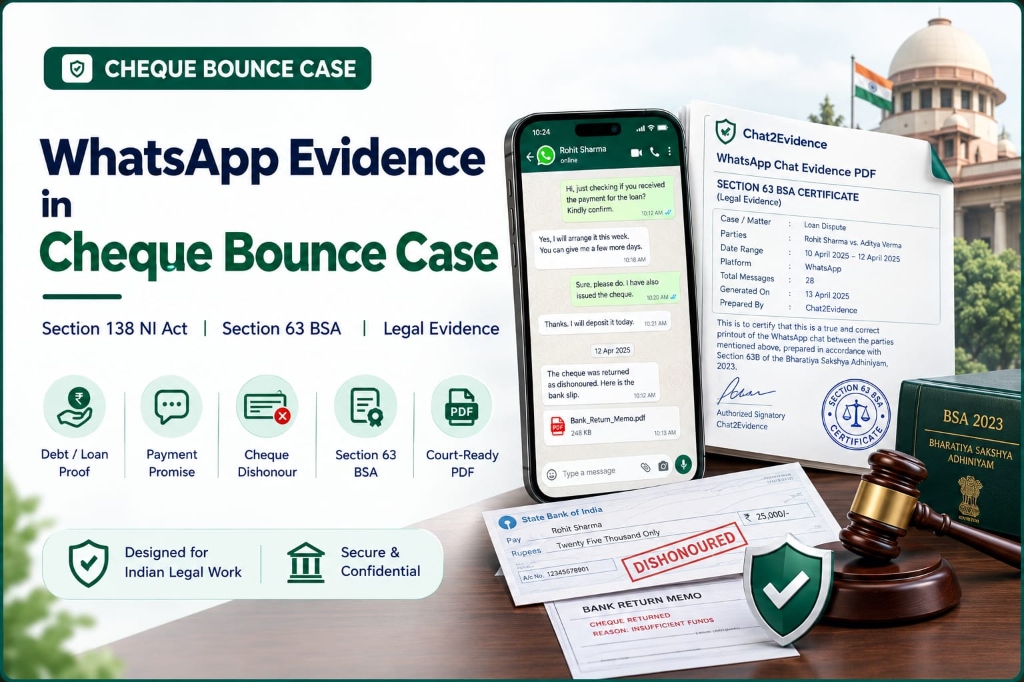
WhatsApp Evidence in Cheque Bounce Cases: The Civil Recovery Track (2026 Guide)
Home › Blog › WhatsApp Evidence in Cheque Bounce Cases (Civil Recovery)
📖 Companion guide: this article covers the civil recovery track. For the criminal prosecution under Section 138 NI Act — demand notices, service rules, trial procedure — see our dedicated WhatsApp Evidence in Section 138 NI Act guide.
Table of Contents
- Quick Answer: Section 138 Punishes — It Does Not Pay You
- The Two-Track Map: Criminal vs Civil vs Both
- Order XXXVII Summary Suits: Where Cheque Bounce Recovery Is Actually Won
- The Limitation Weapon: WhatsApp Acknowledgments Restart the Clock
- The Pre-Filing Gate: Section 12A Mediation and How to Use It
- Building the Civil Evidence File: WhatsApp's Role at Every Stage
- Settlements That Hold: Mediation Awards, Lok Adalat & Consent Decrees
- Cross-Track Strategy: Timelines, Interplay, and Pressure Points
- Drafting Template: Plaint Affidavit Clause for WhatsApp Exhibits
- 7 Fatal Mistakes in the Civil Recovery Track
- Case Study: The Decree That Arrived in Eleven Weeks
- Frequently Asked Questions
- Conclusion & Action Plan
Quick Answer: Section 138 Punishes — It Does Not Pay You
The most common misconception in Indian cheque bounce litigation: "I have filed a 138 case, so the court will make him pay." It will not — at least not as its primary job.
Section 138 NI Act is a criminal provision. On conviction, the drawer faces imprisonment up to two years, a fine up to twice the cheque amount, or both. That punishment creates enormous settlement pressure — especially with interim compensation under Section 143A and compounding under Section 147 — but a criminal court's decree is not a debt-collection mechanism. The cheque amount, contractual interest, and costs are recovered through the civil track: a suit for recovery of money, where bounced-cheque claims on written instruments qualify for the fast-track summary procedure under Order XXXVII CPC.
And in the civil track, WhatsApp evidence plays a different and in some ways bigger role than in the criminal one: it supplies the written acknowledgment of debt that can restart an expiring limitation period (Section 18, Limitation Act), the agreed interest rate referenced in messages (Section 34 CPC), and the admission record that decides the leave-to-defend application — the single hearing that usually determines an Order XXXVII case.
⚡ Bounced cheque + a WhatsApp thread full of admissions? That thread is doing three legal jobs at once — preserving limitation, fixing your interest rate, and pre-winning the leave-to-defend argument. Export and hash it before the debtor gets strategic. Chat2Evidence: 5 minutes, ₹999, zero upload →
The Two-Track Map: Criminal vs Civil vs Both
| Dimension | Criminal Track (Section 138 NI Act) | Civil Track (Order XXXVII CPC / Recovery Suit) |
|---|---|---|
| What it gives you | Punishment of the drawer; settlement pressure; interim compensation up to 20% (Section 143A); compounding (Section 147) | A decree for principal + interest + costs, executable against property and income |
| Who files | Complainant before Magistrate | Plaintiff before Civil Judge / Commercial Court / City Civil Court |
| Defence right | Accused contests at trial (summary procedure) | No automatic defence — leave to defend must be earned with specific facts |
| Burden of proof | Presumptions under Sections 118/139 NI Act favour holder; debt must be proved if rebutted | Plaintiff proves debt on documents; defendant's affidavit must raise a plausible defence |
| Timeline ethos | Supreme Court's Sanjabij Tari (2025) fast-track guidelines | Summary judgment at the leave-to-defend stage; decree in months when the defence is thin |
| WhatsApp evidence role | Proves debt for conviction; notice service; interim compensation leverage | Decides leave to defend; extends limitation (Section 18); contractual interest rate (Section 34); settlement record |
| Can both run? | Yes — parallel proceedings are routinely permitted; different causes of action | Yes — the tracks reinforce each other |
The strategic reading: the criminal track is your pressure instrument; the civil track is your collection instrument. Litigants who understand this file both — or sequence them deliberately. Litigants who don't spend years winning a criminal conviction and still chasing the money.
🚨 Do not assume the criminal court will "adjust" the fine against your dues. Fine amounts and their application are discretionary. If recovery is the goal, recovery must be sued for.
Order XXXVII Summary Suits: Where Cheque Bounce Recovery Is Actually Won
The mechanism
Order XXXVII CPC provides a special procedure for suits on liquidated demands in money arising from written instruments — bills of exchange, hundis, promissory notes, written contracts, guarantees, and enactments. A dishonoured cheque squarely qualifies. Available in High Courts, City Civil Courts, Courts of Small Causes, and courts notified by the High Court.
The defining feature: the defendant has no right to defend. To contest, the defendant must apply for leave to defend before filing any written statement — supported by an affidavit showing specific facts that raise a plausible defence. The judicial test, as High Courts have developed it:
- A bare denial or vague allegation of fraud is insufficient — specific documentary or factual support is required.
- The standard is plausible, not proven — the defence must have "an air of reality," but the court does not conduct a mini-trial.
- Where the defence is thin, courts grant conditional leave — typically requiring the defendant to deposit all or part of the claim amount in court as the price of being allowed to contest.
- Leave is refused where the affidavit defence contradicts the defendant's own prior written acknowledgments — a fact pattern your WhatsApp record was born to create.
The procedural checkpoints (where files are won and lost)
- The plaint endorsement. The plaint must state on its face that the suit is instituted under Order XXXVII. Omit this and the suit is treated as ordinary — you lose the entire procedural advantage by a drafting line.
- The documents. Attach the cheque (or certified copy, with a secondary-evidence affidavit if the original is lost), the return memo, bank statement, the demand notice with proof of service, invoices/contract, and your indexed WhatsApp exhibits.
- The leave-to-defend hearing. Usually the whole case. A defendant who must choose between depositing the claimed amount and going home tends to rediscover payment.
- The decree. Principal + interest under Section 34 CPC + costs. An Order XXXVII decree is an ordinary executable decree — attachment, salary attachment, property execution follow.
Where WhatsApp evidence lands the blow
Map the standard defences to what a certified chat record does to them:
| Defendant's Leave-to-Defend Affidavit Claim | Your Certified WhatsApp Record's Answer |
|---|---|
| "No debt — it was a security/accommodation cheque" | Cheque-number and amount references in chat; quantified balance confirmations preceding the cheque |
| "Debt was repaid" | Post-repayment-period messages acknowledging the outstanding balance; absence of any repayment claim before the memo |
| "Amount is disputed / unliquidated" | The defendant's own message fixing the figure ("8.5 lakh bacha hai") — the claim is liquidated by the defendant himself |
| "Plaintiff fabricated the exhibit" | Section 63 BSA certificate + SHA-256 hash + sealed source media; complete sequence, no excision |
| "Terms never agreed" | Messages negotiating terms, interest, delivery — the contract reconstructed in writing by the parties themselves |
💡 Why summary procedure and certified digital evidence are made for each other: the leave-to-defend decision turns on documents, read cold, at one or two hearings. There is no long evidentiary record in which weaknesses can hide. The party whose documents are complete, attributed, and hash-verified wins this stage almost by default — which is why the marginal value of properly certified WhatsApp evidence is highest precisely here.
The Limitation Weapon: WhatsApp Acknowledgments Restart the Clock
Civil recovery claims live on a limitation clock — for money claims, typically three years from when the right to sue accrues. Cheque bounce plaintiffs routinely discover, often too late, that the oldest dues are expiring or expired. This is where WhatsApp becomes more than evidence: it becomes a limitation-preservation instrument.
Section 18, Limitation Act 1963
Where a person makes a written acknowledgment of liability in respect of a debt before the limitation period expires, a fresh period of limitation begins from the date of that acknowledgment. The acknowledgment must be signed (or, in the electronic era, sufficiently attributable) and must admit or imply the existence of the liability.
Indian courts have repeatedly accepted WhatsApp and electronic messages as written acknowledgments where the sender is attributable — a well-timed "haan, poora paisa dena hai mujhe, 6 mahine mein kar dunga" can restart a claim window that had six weeks left. Practical implications:
- Every chasing message you send is an opportunity — phrase it to invite a quantified acknowledgment: "Please confirm the outstanding is ₹8,50,000 as of today." A reply of "yes" is a fresh three years.
- Preserve each acknowledgment with a hash, the moment it arrives. The limitation value of a message depends on proving it existed — and is attributed — on the date it was sent.
- Serial acknowledgments compound: a debtor who acknowledges yearly keeps the claim alive indefinitely — and builds your admission file as a by-product.
🚨 The boundary: an acknowledgment only extends limitation if made before expiry. Once the three years lapse without an acknowledgment, Section 18 cannot revive the claim (other than the narrow Section 5 condonation route, which is discretionary). The chasing-message habit is cheap; discovering a lapsed claim mid-litigation is not.
The Pre-Filing Gate: Section 12A Mediation and How to Use It
The mandatory gate for commercial disputes
Under Section 12A of the Commercial Courts Act 2015, a commercial dispute of specified value cannot be instituted unless the plaintiff has first exhausted pre-institution mediation — the sole carve-out being suits contemplating urgent interim relief. The Supreme Court in Patil Automation Pvt. Ltd. v. Rakheja Engineers Pvt. Ltd. (2022) held that non-compliance leads to dismissal of the suit itself. (A February 2025 reference in Novenco Building and Industry v. Xero Energy Engineering Solutions has framed the issue for reconsideration — file as if Patil Automation governs, because until it is revisited, it does.)
Under the Mediation Act, 2023, pre-litigation mediation is voluntary for ordinary civil disputes — but a settlement reached in a mediation under that Act is enforceable as if it were a judgment or decree, which makes a mediated settlement vastly stronger than a private WhatsApp promise.
The honest economics — and how certified evidence changes them
The empirical record on mandatory commercial mediation is sobering: research cited by EAC-PM found that between 2020 and 2023 roughly 98% of pre-litigation mediation applications in Mumbai's district courts were non-starters, and DAKSH/IIT Delhi research found that mandating mediation in cheque bounce cases adds about three hearings and 100 days to disposal. Mediation imposed on a debtor who has no intention to pay is delay, not remedy.
Which is exactly why the evidence file matters at this gate. A debtor facing a certified, hash-verified chat record of quantified admissions arrives at mediation in a different posture than one facing screenshots:
- The "no debt" posture collapses before the mediator reads page 10.
- Settlement discussions start from how and when to pay — not whether anything is owed.
- Your mediation brief can put the exhibit bundle on the table on day one, turning the 98%-non-starter statistic into someone else's problem.
The strategy
- If your claim is a commercial dispute of specified value, complete Section 12A mediation (DLSA or institutional) before filing — or have your advocate assess the genuine urgency carve-out honestly; courts police "disguised" urgency prayers (Yamini Manohar v. T.K.D. Keerthi).
- Walk into mediation with the same certified exhibit bundle you would file — chronological PDF, certificate, hash record.
- If mediation fails, file with the non-settlement report attached; the failed mediation costs you weeks, but your evidence file is already trial-grade.
Building the Civil Evidence File: WhatsApp's Role at Every Stage
| Stage | WhatsApp Evidence's Job | Compliance Layer |
|---|---|---|
| Pre-suit chasing | Generates Section 18 acknowledgments; documents the demand | Export + hash each acknowledgment as it lands |
| Demand notice | Service proof (WhatsApp + registered post dual track) | Notice protocol |
| Section 12A mediation | Collapses denial; anchors realistic settlement numbers | Certified exhibit bundle presented to mediator |
| Plaint filing | Exhibits proving debt, liquidated amount, interest terms | Section 63(4) BSA certificate + index + sealed media |
| Leave-to-defend hearing | Answers the defence affidavit; drives conditional leave or refusal | Hash-verified completeness; +91 attribution |
| Trial (if leave granted) | Primary documentary evidence; cross-examination foundation | Original device readiness; sealed source media |
| Execution | Judgment-debtor negotiation leverage; discovery of assets via admissions | Record of post-decree acknowledgment messages |
The compliance layer does not change across stages — one properly built artefact (chronological PDF + certificate + hash + sealed media) serves all of them. That is the point of building it once, correctly, at the start.
Settlements That Hold: Mediation Awards, Lok Adalat & Consent Decrees
A settlement is only as good as its enforceability. Know the hierarchy:
| Settlement Form | Legal Force | Why It Holds (or Doesn't) |
|---|---|---|
| Private WhatsApp promises | None, directly — evidence of terms only | Enforceable only by suing on them; betrays trust in a debtor who already broke one promise |
| Mediated Settlement Agreement (Mediation Act 2023) | Enforceable as if a judgment/decree | The statutory gold standard short of trial |
| Lok Adalat award (Section 21, Legal Services Authorities Act 1987) | Deemed decree of a civil court | Free, fast, final; no appeal on merits |
| Consent decree in the suit | Decree by agreement | Enforceable immediately; non-compliance straight to execution |
| Compounding in the pending 138 case | Criminal closure; payment terms as recorded | The criminal pressure ends the moment compounding is recorded — sequence payments before full closure |
WhatsApp's role in each: your certified chat record is the evidentiary base on which the mediator, Lok Adalat panel, or judge settles the numbers — and it disciplines the debtor's expectations before the first session begins. Post-settlement, continue preserving: installment acknowledgments, bounced-installment notices, and fresh Section 18 acknowledgments keep the file alive if the settlement itself is breached.
Cross-Track Strategy: Timelines, Interplay, and Pressure Points
Sequencing options that work
- Civil-first: file the Order XXXVII suit immediately (with Section 12A completed where applicable), let the leave-to-defend deposit demand create pressure, settle on consent decree. Best when the debtor has attachable assets.
- Criminal-first: the 138 complaint with its interim-compensation application is often faster to file and psychologically heavier; compounding negotiations then fund the civil settlement. Best when the debtor fears conviction more than payment.
- Parallel: both tracks together, coordinated by one advocate. Routine and effective — the tracks do not obstruct each other, and each hearing in either track reminds the debtor of the other.
The pressure map
Certified WhatsApp record
        │
        ├──► 138 complaint → summons → 143A interim compensation (up to 20%)
        │                        → silence after notice (Sanjabij Tari inference)
        │
        └──► Order XXXVII plaint → leave-to-defend application
                                 → deposit-or-defend choice
                                 → decree + Section 34 interest + execution
Every node of that map is stronger with a hash-verified exhibit than without — and weaker, sometimes fatally, with screenshots.
Drafting Template: Plaint Affidavit Clause for WhatsApp Exhibits
Adapt with your advocate to your forum's verification rules:
VERIFICATION PARAGRAPH — ELECTRONIC EXHIBITS (Ex. C-__ series)

I, [FULL NAME], [age], [occupation], resident of [address], verify and declare:

1. I am the plaintiff and the person in charge of mobile number +91-[MY NUMBER],
   registered in my name since [month/year], and of the WhatsApp account operated
   thereon.

2. The documents annexed as Ex. C-[__] are a true, complete and chronological
   record of the WhatsApp conversation between +91-[MY NUMBER] and +91-[DEFENDANT
   NUMBER] concerning the transaction underlying the dishonoured cheque no. [____]
   dated [__] for Rs. [____], exported by me on [DATE] via WhatsApp's native
   export function with media, and converted to the annexed PDF without addition,
   deletion, alteration or reordering.

3. The said conversation contains written acknowledgments of liability by the
   defendant, including [quote the key acknowledgment(s) with date], and records
   the agreed interest terms [quote], relied upon under Section 18 of the
   Limitation Act, 1963 and Section 34 of the Code of Civil Procedure, 1908.

4. The SHA-256 hash of the exported record, computed on [DATE], is [64-CHARACTER
   HASH]; the annexed exhibits and the sealed media bear the identical hash, and
   no alteration whatsoever has been made since.

5. The device particulars are: [make/model], IMEI [____], [OS + version]. The
   record was produced in the ordinary course of communications on a device
   regularly used by me and operating properly throughout.

Verified at [City] on this [__] day of [Month], 2026.

[Signature] [Full Name]
⚡ The bundle this clause describes is exactly what Chat2Evidence generates from your export ZIP — chronological PDF, certificate with the hash printed on it, index and sealed-media checklist. Build it in 5 minutes →
7 Fatal Mistakes in the Civil Recovery Track
🚨 Mistake 1 — Filing only the 138 case and waiting for the money. Punishment is not payment. Without a civil decree you have pressure without a collection mechanism.
🚨 Mistake 2 — Forgetting the Order XXXVII endorsement on the plaint. One omitted line converts your fast track into an ordinary five-year suit.
🚨 Mistake 3 — Letting limitation lapse while "being nice" on WhatsApp. Every un-acknowledged year burns limitation. Chase in writing, invite quantified confirmations, and preserve them hashed.
🚨 Mistake 4 — Skipping Section 12A in a commercial dispute. Patil Automation dismissal is a real outcome. Mediation with a certified exhibit file is an asset, not a chore.
🚨 Mistake 5 — Accepting private WhatsApp promises as "settlement." Until terms are a mediated settlement agreement, Lok Adalat award, consent decree, or compounding order, you hold evidence — not an enforceable right.
🚨 Mistake 6 — Filing uncertified chat printouts in a documents-decided forum. A summary suit is won on paper at the leave-to-defend stage. Paper without a Section 63 BSA certificate is an objection waiting to be sustained.
🚨 Mistake 7 — Compounding the 138 case before the money lands. The criminal pressure evaporates at compounding. Record payment first, closure after.
Case Study: The Decree That Arrived in Eleven Weeks
A composite case study based on a common commercial-recovery pattern. Figures illustrative; mechanics exactly as described.
The dispute: A Pune CNC-parts supplier held three dishonoured cheques totalling ₹42 lakh from a machine assembler. The assembler's lawyer had perfected the delay playbook in a prior 138 matter: adjournments, service objections, a jurisdiction challenge.
What the supplier's advocate did differently — the civil track:
- Week 1: Exported the full business chat (with media), hashed it, and converted it to a certified chronological PDF — the assembler's own messages fixed the debt: "42 ka breakup: 18+14+10 — teeno cheque isi liye diye."
- Week 2: Completed pre-institution mediation (Section 12A — the claim was commercial). The exhibit bundle went to the mediator on day one. The assembler's "quality dispute" posture lasted one session; no settlement, but a non-settlement report and — crucially — the assembler's own mediation-session admissions.
- Week 4: Order XXXVII plaint filed with the endorsement, indexed exhibits, and the verification clause above. Leave-to-defend application followed.
- Week 8: Hearing. The defence affidavit alleged "fabricated chats" and "disputed dues." The advocate's reply ran one page: Section 63 BSA certificate; hash verification demonstrated in open court; and the defendant's own mediation admission on record. The court found no specific facts raising a plausible defence — and the allegations of fabrication, unsupported by anything, failed on their face.
- Week 11: Leave refused; decree for ₹42 lakh plus contractual interest (the chat-referenced 18% p.a.) plus costs. The assembler paid in full within the execution-notice period rather than face attachment.
The transferable lessons:
- The leave-to-defend stage is the trial. Eleven weeks beats eleven years because the case was decided where summary suits are decided.
- The certified chat record did triple duty — limitation anchor, interest-rate proof, and leave-killer.
- Section 12A mediation, entered with evidence rather than hope, produced settlement pressure even though it produced no settlement.
Frequently Asked Questions
1. Should I file the 138 case or the civil suit first?
If the debtor has attachable assets and the debt is documented, the Order XXXVII suit is usually the faster route to money. If psychological pressure and speed-to-filing matter more (or the debtor is judgment-proof but reputation-sensitive), 138 first works. With a certified evidence file, parallel filing is also routine — ask your advocate to map your debtor.
2. Does the 3-year limitation apply to the cheque itself?
Civil limitation for recovery on a dishonoured instrument typically runs three years from when the right to sue accrues — for a cheque, generally from dishonour or the failed notice window, depending on how the claim is framed. Section 18 acknowledgments restart the clock. Do not self-assess limitation from an article — have your advocate date-map it; the cost of a lapsed claim is total.
3. What if the debtor ignores the mediation process?
Non-participation yields a non-starter/non-settlement report, which is your ticket to file. The 98%-non-starter statistics reflect debtors stalling — arrive with evidence, and their stalling still ends with you filing.
4. Can WhatsApp messages really set my interest rate?
Where messages record an agreed rate, courts have treated them as evidence of the contract's terms and awarded interest accordingly under Section 34 CPC. Preserve the rate-referencing messages with the same hash discipline as the principal admissions.
5. Is a group-chat acknowledgment valid as a Section 18 acknowledgment?
Attribution is the battleground in groups — the message must be shown to be the defendant's. Number attribution, voice notes, and chat context carry it. Where attribution is contestable, supplement with the telecom/SIM particulars route.
6. My chat is in Marathi/Hindi — does that weaken the civil file?
No, if handled properly: original-language certified exhibits with a certified translation annexure. In Maharashtra and most states, vernacular originals are routine. Machine-translating the exhibit itself is the error.
7. What does the whole civil-track evidence package cost?
Self-managed: free but multi-day. Chat2Evidence: ₹999 for the certified chronological PDF + Section 63 BSA certificate + hash. Forensic lab: ₹15,000–₹50,000 where the stakes justify it. Advocate fees are separate in every scenario.
Conclusion & Action Plan
The criminal track makes the debtor afraid; the civil track makes you paid. Cheque bounce recovery in 2026 rewards litigants who treat WhatsApp as what it legally is: a running, written, attributable record of the debt — capable of preserving limitation, fixing interest, and ending defences before they are fully formed.
Your action plan:
- Today: Export and hash the debtor chat; send one well-phrased message inviting a quantified acknowledgment (Section 18 insurance); preserve the reply hashed.
- This week: Complete the Section 12A step if your claim is commercial; build the certified exhibit bundle either way.
- Before filing: Date-map limitation with your advocate; endorse Order XXXVII on the plaint; assemble the indexed exhibits.
- At the leave-to-defend hearing: Put the hash-verified record on top of the file. Let the defence choose between depositing and going home.
Your three options
| Option | What You Get | Best If |
|---|---|---|
| 1. DIY evidence (Free) | Manual export, hashing, self-drafted certificate | Small claims, ample time |
| 2. Chat2Evidence — ₹999 (Recommended) | Certified chronological PDF + Section 63 BSA certificate + SHA-256 hash in ~5 min, zero upload | Every recovery file where the documents decide the case |
| 3. Forensic lab (₹15,000–₹50,000) | Imaging + expert report | Contested fabrication battles |
⚡ Build your recovery evidence file in 5 minutes — ₹999, zero upload, Section 63 BSA certificate and SHA-256 hash included. India's only client-side WhatsApp-to-court-evidence converter.
Related Guides
- WhatsApp Evidence in Section 138 NI Act Cheque Bounce Cases — the criminal track: notices, service rules, trial procedure
- How to Authenticate WhatsApp Screenshots for Court Submission — the Section 63 BSA protocol
- WhatsApp Chronological PDF for Legal Proceedings — the court-format specification
- Convert WhatsApp ZIP to Court-Admissible PDF — the conversion mechanics
- WhatsApp Business Chat as Legal Evidence — B2B claims and agency issues
Disclaimer: This guide is legal information, not legal advice, and does not create an advocate-client relationship. Statutes and case law are stated as of September 2026. Limitation analysis is fact-specific — consult a qualified advocate for your matter.