Section 63 BSA Certificate Template — Free Download
(Schedule Format, Part A + Part B) | Bharatiya Sakshya Adhiniyam 2023
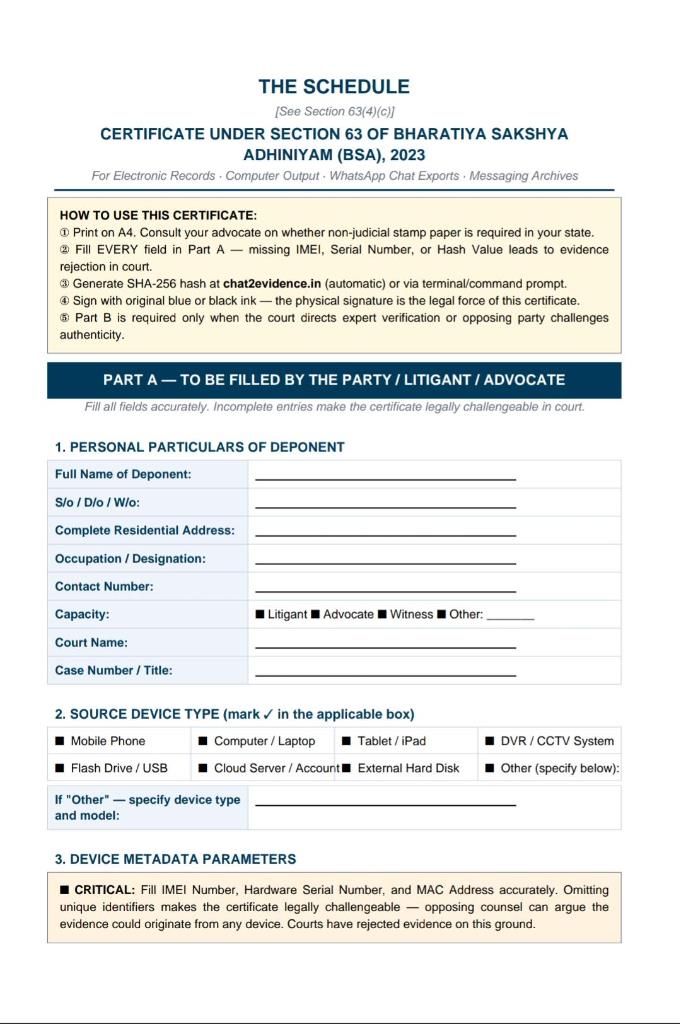
Download the official two-part certificate format mandated under Section 63(4)(c) BSA 2023. Court-ready with SHA-256 hash fields, IMEI/device metadata logging, system integrity declaration, and dual-signatory compliance — used by advocates, litigants, and forensic experts across Indian trial courts.
New to Section 63 BSA? Before downloading, read our complete beginner's guide on what the Section 63 BSA certificate is, why it replaces Section 65B, and how to fill Part A & Part B — then return here to download the template.
What Is a Section 63 BSA Certificate? (Quick Summary)
A Section 63 BSA Certificate is a mandatory legal declaration required under the Bharatiya Sakshya Adhiniyam, 2023 to validate electronic evidence in Indian courts. It replaces the erstwhile Section 65B certificate of the Indian Evidence Act, 1872, which became obsolete on July 1, 2024.
The certificate has two parts: Part A — filled by the party in charge of the device, declaring device ownership, IMEI, serial number, MAC address, and cryptographic hash values — and Part B — filled by an independent expert who verifies technical integrity. Without this dual-certificate compliance, electronic records including WhatsApp chats, emails, CCTV footage, and call recordings are inadmissible as evidence under Section 63(4).
From Section 65B to Section 63 BSA — What Changed
The Bharatiya Sakshya Adhiniyam (BSA), 2023 — Act No. 47 of 2023 — came into force on July 1, 2024, completely repealing the Indian Evidence Act, 1872 for all new proceedings. Every litigant and advocate must now comply with Section 63 BSA for electronic evidence admissibility.
| Aspect | Section 65B (IEA 1872) — Old | Section 63 (BSA 2023) — Current |
|---|---|---|
| Scope of Devices | Limited to "computer output" | Expanded to computers + communication devices — mobiles, servers, cloud, DVRs |
| Certificate Signatories | One person in responsible official position | Dual signatory: Person in charge + an independent expert |
| Hash Value Requirement | Not explicitly mandated | Mandatory — SHA-256, SHA-1, or MD5 must be recorded in Schedule format |
| Certificate Format | No statutory format prescribed | Mandatory Schedule format with Part A and Part B |
| Evidence Classification | Secondary evidence | Primary evidence under Section 57 BSA |
| Submission Timing | Ambiguous — could be produced later | Must be submitted "at each instance" of admission |
In May 2026, the Supreme Court of India upheld the constitutionality of Section 63(4) BSA, confirming that the dual-certificate requirement is mandatory and cannot be waived, and that the hash value is synonymous with an electronic fingerprint.
Section 63 BSA Compliance Checklist — 12 Mandatory Part A Parameters
Missing any element below is the #1 reason courts reject electronic evidence under Section 63. Verify every field before signing.
| # | Mandatory Field | What to Enter | Why Courts Reject |
|---|---|---|---|
| 1 | Full Name & Parentage | Complete name, S/o, D/o, or W/o details | Incomplete identity — court questions who certified |
| 2 | Residential / Employment Address | Complete address or employment registration | Vague addresses render affidavit non-verifiable |
| 3 | Source Type Identification | Tick-box: Computer, DVR, Mobile, Flash Drive, Cloud, or Other | Selecting "Other" without specifying |
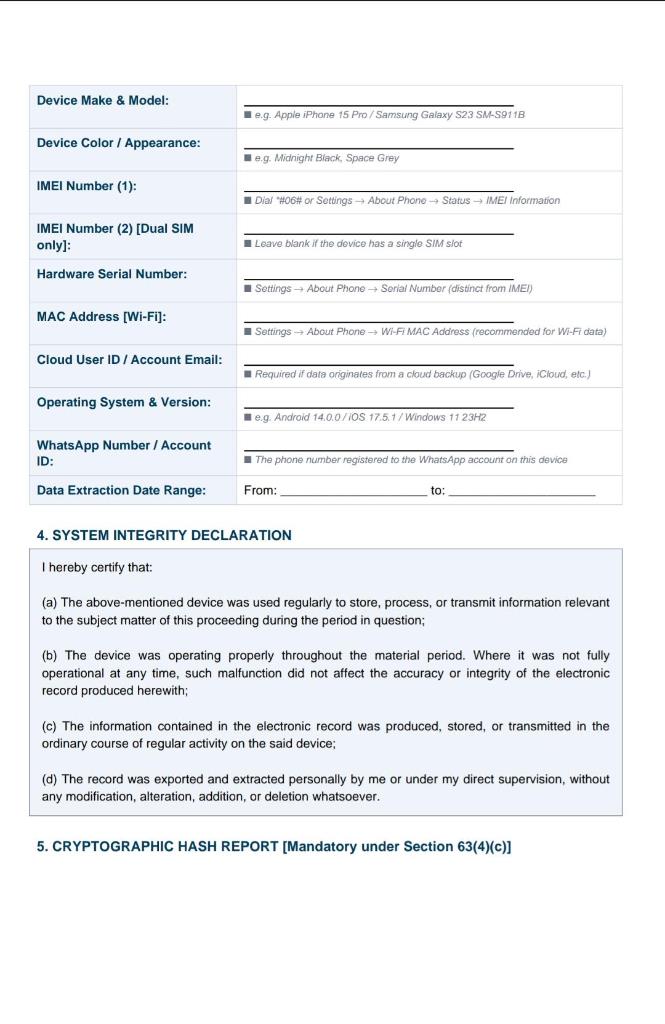
| 4 | Device Make & Model CRITICAL | Exact manufacturer + model number (e.g. "Apple iPhone 15 Pro") | Generic entries like "Samsung phone" — courts need source attribution |
| 5 | IMEI Number CRITICAL | Dial *#06# — record both IMEI numbers for dual-SIM devices | Missing IMEI — opposing counsel challenges device source identity |
| 6 | Hardware Serial Number CRITICAL | Settings → About Phone → Serial Number | Confused with IMEI or left blank |
| 7 | MAC Address | Settings → About Phone → Wi-Fi MAC Address | Missing for Wi-Fi-sourced data |
| 8 | Lawful Control Declaration | State: Owned / Maintained / Managed / Operated by you | Unclear relationship to the device |
| 9 | System Integrity Clause | Affirm device operated properly; if not, explain why accuracy was unaffected | Blank or generic "working fine" without specifics |
| 10 | Hash Algorithm CRITICAL | Tick SHA-256 (recommended), MD5, or SHA-1 | Selecting MD5 for high-stakes litigation (known vulnerabilities) |
| 11 | Full Hash Value String CRITICAL | Complete 64-character (SHA-256) or 32-character (MD5) hex string | Truncated, copied incorrectly, or missing hash report enclosure |
| 12 | Physical Signature | Hand-signed in original blue or black ink | Unsigned or digitally signed without court-accepted e-signature compliance |
Step-by-Step: How to Build a Court-Admissible Section 63 Certificate
Determine whether your evidence comes from a mobile phone, computer, cloud server, or DVR. Collect device make, model, IMEI (dial *#06#), and serial number before opening the template. Missing these at the time of filling forces you to re-sign the document.
Common sources: WhatsApp chats → Mobile Phone + possible cloud backup. Emails → Server/cloud + local client. CCTV → DVR/NVR. Banking logs → Server + intermediary.
For WhatsApp: Open conversation → Three-dot menu → More → Export Chat → Without Media (for text) or Include Media (for multimedia). Save the .txt or .zip to a write-protected location. Do not rename, open, or edit the file — any modification changes the hash value and invalidates the certificate.
The hash is the digital fingerprint of your file. Run it immediately after export, before any file transfer. Use Chat2Evidence for automatic one-click hash computation, or use your OS terminal:
| Operating System | Command |
|---|---|
| Windows CMD | certutil -hashfile C:\path\to\file.txt sha256 |
| Windows PowerShell | Get-FileHash C:\path\to\file.txt -Algorithm sha256 |
| macOS Terminal | shasum -a 256 /path/to/file.txt |
| Linux / Ubuntu | sha256sum /path/to/file.txt |
The output is a 64-character hexadecimal string. Copy it exactly — every character matters.
Using the downloaded template, fill every field methodically. Use exact device specifications — check Settings → About Phone for IMEI and serial numbers. Paste the full hash string — do not truncate. Select the correct algorithm checkbox. Do not leave any field blank unless it genuinely doesn't apply (e.g. IMEI-2 for single-SIM devices).
Part B is mandatory when the opposing party challenges authenticity, the court directs expert verification, or the case involves cybercrime / financial fraud / high-value commercial disputes. The expert must independently re-calculate the hash and confirm it matches Part A. Courts prefer accredited forensic laboratories (CFSL, DFSL, or NABL-certified private labs).
Sign in original blue or black ink — the physical signature is the legal force of the certificate. Then submit to court: the electronic record (printout or forensic image), the signed Section 63(4)(c) certificate (Part A + Part B if applicable), the separate hash report referenced in the certificate, chain of custody documentation, and a supporting affidavit if required by local court rules.
Timing Rule: The certificate must be submitted "at each instance where the electronic record is being submitted for admission" — not at final arguments. Produce it when the evidence is first marked.
SHA-256 vs MD5 — Which Hash Algorithm to Use?
✅ SHA-256 — Strongly Recommended
Produces a 256-bit, 64-character hexadecimal string. Collision-resistant — no two different files can produce the same hash. The gold standard for court submissions under BSA 2023. Required for cybercrime, criminal trials, and high-value commercial disputes.
MD5 — Accepted but Weaker
Produces a 128-bit, 32-character string. Has known theoretical collision vulnerabilities. Legally valid under Section 63 BSA but vulnerable to challenge in cross-examination for high-stakes cases. Acceptable for straightforward matrimonial or maintenance matters.
Court-Ready PDF Template Preview
WATERMARK REMOVED
ON PURCHASE
WATERMARK REMOVED
ON PURCHASE
🔒 Page Locked
Page 3 of 6 contains the Annexure Table and critical Hash Report format.
🔒 Page Locked
Page 4 of 6 contains the official instruction guidelines and verification checklist.
🔒 Page Locked
Page 5 of 6 contains Part B certification template for Cyber Forensic Experts.
🔒 Page Locked
Page 6 of 6 contains the forensic tools logging table and signature validation.
Download Your Section 63 BSA Certificate Template
Official Schedule format under Section 63(4)(c) of the Bharatiya Sakshya Adhiniyam, 2023 — Part A & Part B included. Free to download and edit.
⏰ Don't risk evidence rejection. Courts are strictly enforcing Section 63(4) compliance since July 2024.
Looking for the complete beginner's guide to Section 63 BSA — covering what it is, the full Schedule Part A & Part B field breakdown, use cases for divorce, 498A, and cybercrime, and why screenshots are rejected? Read our in-depth resource: Section 63 BSA Certificate Template — Complete Legal Guide →
Frequently Asked Questions — Section 63 BSA Certificate Download
- Government-authorized forensic laboratories (CFSL, DFSL, or state forensic science labs)
- Examiners of Electronic Evidence notified under Section 79A of the IT Act, 2000
- Independent digital forensic experts with verifiable credentials and institutional backing
- Incomplete technical specifications — Missing IMEI, vague device descriptions ("Samsung phone" instead of "Samsung Galaxy S23 SM-S911B")
- Hash value errors — Truncated hash strings, incorrect algorithm selection, or failure to enclose the separate hash report
- Unqualified signatories — Part A signed by someone without lawful control, or Part B by a person without verifiable forensic expertise
- Chain of custody gaps — No documentation tracking device handling from seizure to courtroom
- Missing Part B when directed — Failing to produce expert certification when court directs or opposing party challenges authenticity
- No technical metadata — No IMEI, MAC address, or device source identifiers. Courts cannot verify when or on which device the screenshot was created.
- No hash verification — Screenshots can be manipulated in any photo editor. Without SHA-256 hash values, there is no tamper-detection mechanism.
- No reproducible production process — Section 63(4)(c) requires describing "the manner in which the record was produced." Screenshots have no reproducible process.
_chat.txt file, compute its SHA-256 hash, and certify it under Part A.